Top Veterinary Behaviourist Finally Reveals the 8‑in‑10 Statistic Your Vet Mentioned Once — Then Never Brought Up Again...
After her own client received a landlord's letter warning that one more noise complaint would cost her the tenancy, a veterinary behaviourist with 22 years in practice exposed the real data behind separation anxiety — and the all-clear signal breakthrough that's helping 6,400+ owners finally address the panic alarm that crates, collars and tablets leave completely untouched.
 Written by Dr. Eleanor Vance, Veterinary Behaviourist, 22 Years in Practice | Reviewed by the Companion Animal Behaviour Case Registry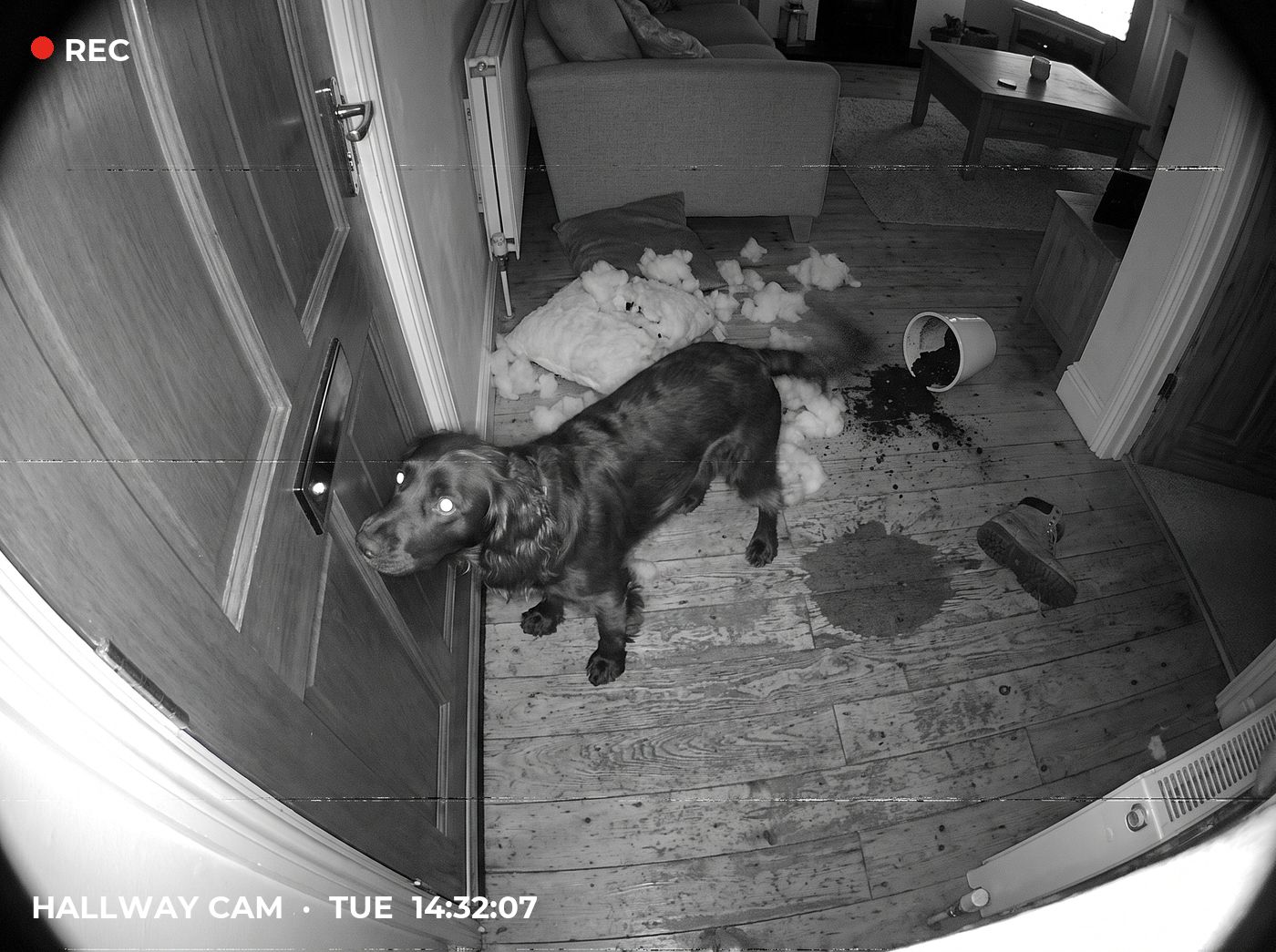
Here's a number your vet said once and then moved on from so quickly you almost missed it:
8 out of 10 dogs find it hard to cope when left alone. And half of them — 1 in 2 — show no obvious signs.
Let that land.
That dog in your house right now, the one curled on the sofa while you read this at work, the one who settled when you left this morning? He might not be settled at all. He might be frozen in a silent panic you have no way of seeing.
Not howling. Not barking. Not scratching the paint. Just... silent. Stuck. Heart rate through the roof, every muscle tense — and nobody, not even the camera you've just bought, can tell you what's really happening inside his head.
It is impossible to know which kind yours is.
Not difficult. Impossible.
No vet on earth — not the best referral hospital in the country, not my own behaviour clinic with its 7,400 cases — can look at your dog on a consult table and tell you with certainty: "He'll howl the place down the moment you leave," or "He'll be one of the silent ones."
They can't.
The science doesn't exist yet.
So what do they do instead?
They tell you to crate him. Or leave a radio on. Or tire him out with a long walk before you go. Or ignore him when you walk back in. Or "keep going, he'll get used to it."
Meanwhile, the question that lives in the back of your skull — the one you think about when your hand is on the door handle, when your phone lights up with a camera alert, when you see a handwritten note stuck to your front door — never gets answered:
"What is he going through right now?"
If that question has been living in your head — keep reading. Because the next 5 minutes will change the way you understand what's happening to your dog, why nothing you've tried switches the panic off (including the plug-in you may have already tried), and what the owners who got their lives back did differently.
My name is Dr. Eleanor Vance.
I've spent 22 years as a veterinary behaviourist, running a referral behaviour clinic in the Midlands where I've treated over 7,400 dogs. I developed a four-room departure protocol used by behaviourists across the country. I've seen more separation cases than I can count — and I've been complicit in making them worse.

And I'm about to show you the real data from my case files — the numbers the containment industry buries because they'd bankrupt every crate manufacturer, every bark-collar seller and every "calming chew" brand in the country if owners actually understood them.
THE NIGHT EVERYTHING CHANGED...
It was Tuesday, 14th March 2023.
Rachel Hartley had been my client for 14 months. She was 44, a school receptionist, living in a rented semi-detached house with a shared wall on one side. Her dog was a 4-year-old working cocker spaniel called Bramble — perfect when Rachel was home, and a wreck the second the door shut.
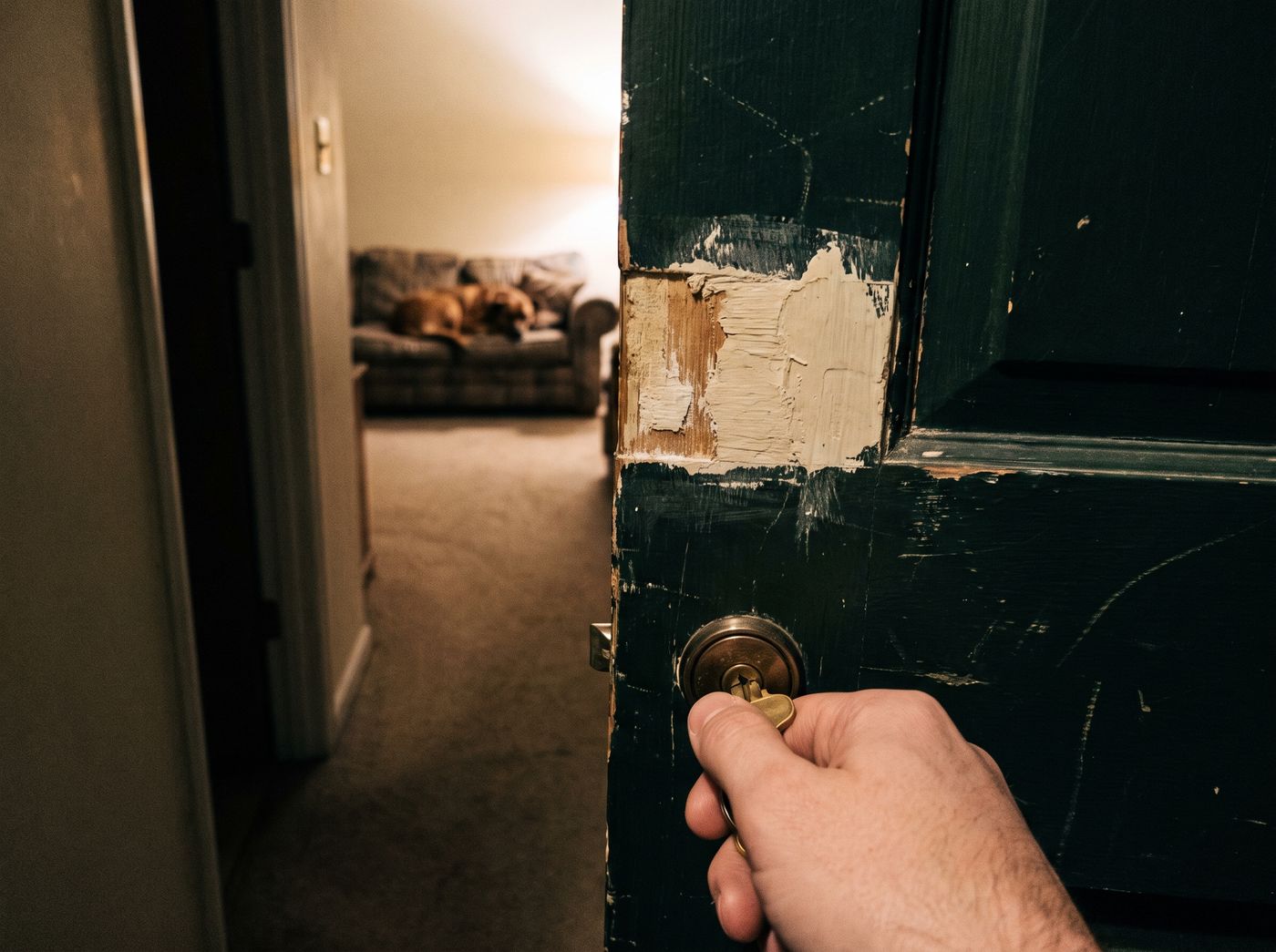
Rachel was the kind of owner who kept everything. A spreadsheet of every departure. Printed camera stills with timestamps in the corner. The behaviourist invoices, the medication packets. And the piece of paper that had brought her to me in the first place: a handwritten note from next door, slipped through the letterbox while she was out for forty minutes at the shops.
She walked into my consulting room that afternoon and placed two sheets of paper on my desk.
The first was the departure spreadsheet. Across 9 months, Rachel had logged 214 times she'd left the house. The camera had saved 63 separate clips of Bramble howling, pacing, pawing at the front door, panting so hard his whole body shook. The longest silence in any recording was 21 seconds.
The second sheet was the total.
£4,860.
| Date | Left | Back | First howl | Notes |
|---|---|---|---|---|
| Mon 16 Jan | 08:05 | 15:52 | +2 min | howl, pawing at door |
| Sat 4 Feb | 10:30 | 11:10 | +1 min | neighbour knocked |
| Wed 22 Feb | 07:58 | 16:04 | +3 min | crate bars chewed |
| Thu 2 Mar | 19:40 | 21:45 | +1 min | 21 sec quiet — longest |
| Mon 13 Mar | 08:02 | 15:47 | +40 sec | note through the door |
- Behaviourist, 8 sessions£1,200
- Dog sitter, 26 days£2,080
- Online trainer£370
- Fluoxetine, 6 months£570
- Trazodone, 4 months£168
- Departures app + 6 months£204
- Crate£120
- Bark collar£47
- Pet camera£38
- Plug-in diffuser + refill£38
- Calming chews£25
She looked me in the eye and asked the question I will never forget:
"Dr. Vance, you've treated over seven thousand dogs. You've got my spreadsheet. I have a neighbour who's left a note, a landlord who's sent a letter saying one more complaint and we lose the tenancy, and a dog who howls from the moment I shut the door until the moment I turn the key. With everything I've tried — with everything you've tried — tell me honestly: what are his odds of ever being okay alone?"
I opened my mouth. And closed it.
Because here's what my case files actually say — what I knew and she somehow also knew:
Of the last 380 separation cases I'd treated over the previous five years, 49% had ended in either rehoming or an eviction notice. Nearly half.
Rachel held up her hand before I could say anything.
"I've read about the family who had to give their dog up because two noise complaints meant they'd be evicted. The dog came back three weeks later because the new family couldn't cope either. That's going to be me. So please — I'm not asking for another handout on sub-threshold training. I'm asking you: is there anything that actually switches the alarm off?"
There is no phrase in dog behaviour more quietly terrifying than "he'll get used to it."
Rachel had turned down four invitations that year. Not because of what Bramble did. Because of what the landlord's letter said.
And I just stood there.
Useless.
A veterinary behaviourist who had prescribed those same crate protocols to hundreds of families.
I'd tried everything 22 years had taught me:
Crate Protocol — Six weeks of desensitising Bramble to the largest crate the pet shop sold: meals inside, the door shut for a second, then a minute, then ten. She'd come home to chewed bars, torn bedding, and Bramble's gums bleeding where he'd tried to bite through the metal. She never shut the crate door again.
Graduated Departures ("Door Is a Bore") — £90 for the app and £19 a month for 6 months. Literally thousands of trips to the front door: pick up keys, put them down, step outside for one second. She never got past 11 seconds. "Every dog who 'graduated' was on medication," she told me. "The method didn't fix them. The tablets did."
Behaviourist Sessions (Me) — £150 an hour, eight sessions across 14 months. She did everything I asked. And on the days I couldn't answer my phone, she sat in her car outside the supermarket, watching the camera feed, because Bramble had started howling at minute 7 and hadn't stopped for an hour.
Bark Collar (Citronella) — £47, bought after the neighbour's note. On the fourth departure she found it cracked on the hallway floor, and a recording of him howling anyway — just quieter, more broken. He'd learned to panic in silence. That was worse.
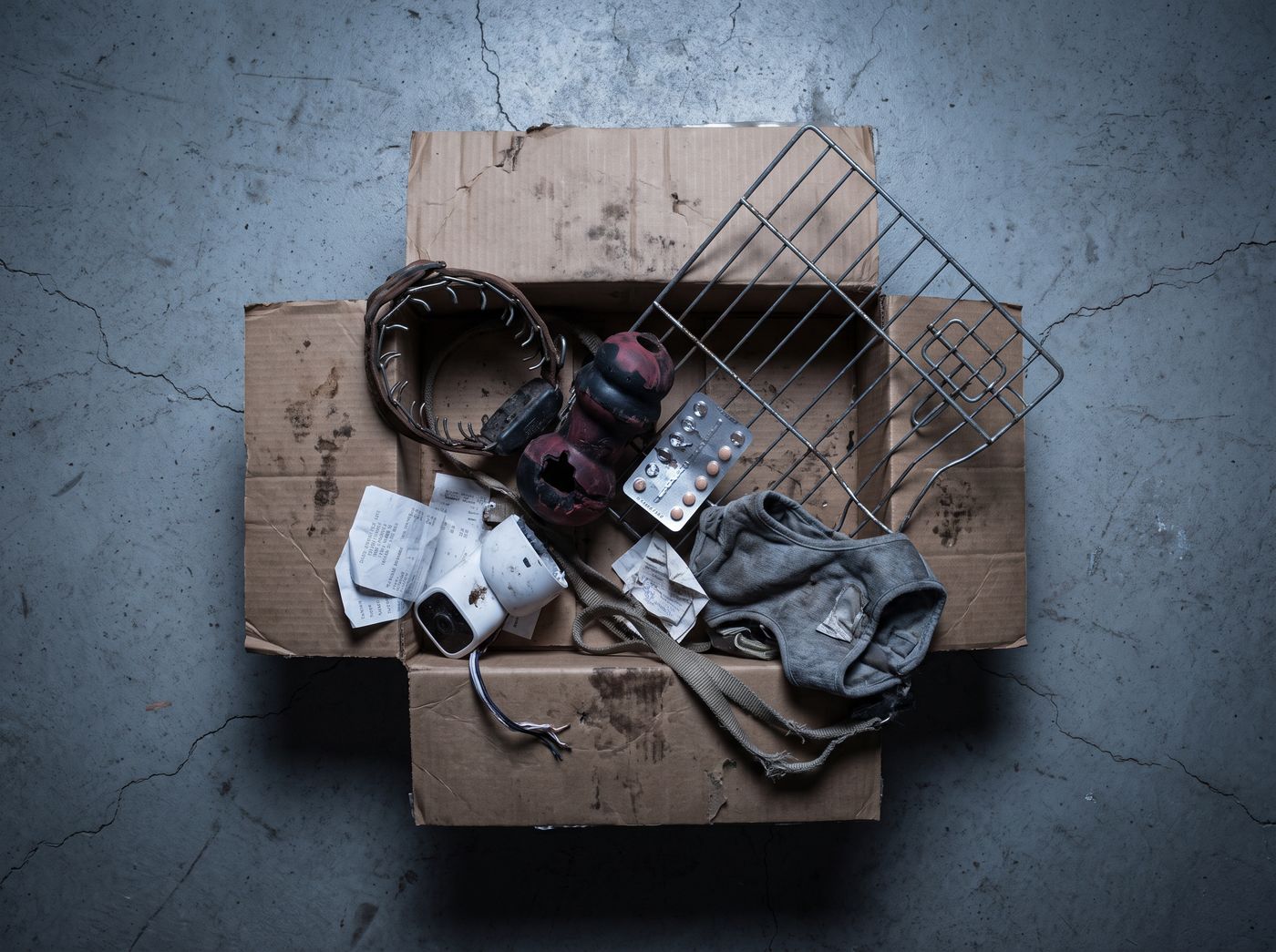
Camera — £38. During a parents' evening at her school, it sent her 60 alerts in one hour. Her head teacher pulled her aside: "You checked your phone fifty times tonight. Is everything okay?"
Fluoxetine and Trazodone — £95 a month, then £42 a month on top. Bramble got quieter, not calmer. "I don't like seeing a zombie," Rachel said. "He's not himself. He still panics when I leave. He's just too dazed to do anything about it."
The Plug-In Diffuser — A supermarket brand, plugged into the hallway socket the night before she went back to work after Christmas. She unplugged it at night to make it last. The refill ran out on day 19, and she didn't notice until the neighbour slipped another note through the door.
Nothing broke the cycle.
The experts weren't any better.
Her local vet offered fluoxetine and a leaflet on crate training.
The trainer she found online? £370 for a "6-week guarantee" — leave him with a stuffed Kong and ignore the barking.
The behaviourist (me)? Fourteen months of doing what the textbooks said.
That night, staring at Rachel's spreadsheet — 214 departures, 63 clips, the 21-second silence, £4,860, a 49% chance of losing the dog or the house — a woman who had done everything the professionals asked for over a year, and had finally asked the one question the containment industry is designed never to answer...
Something inside me snapped.
I wasn't going to recommend another crate protocol I already knew would leave the root cause completely untouched.
I was going to figure this out.
Or die trying.
THE MIND-BLOWING DISCOVERY
For the next 97 days, I lived like a woman possessed.
I read 11,106 owner stories from five countries — the UK, Ireland, Australia, New Zealand and Canada — posted on forums, in Facebook groups, in the comment sections of trainers' videos. Every single one described the same loop: the dog falls apart when the door closes, they try everything, nothing breaks the cycle.
I combed through my own 1,380 case files from 2003 to 2025. I called 41 behaviourists and vets I respected, across three continents, and asked them one question: "What actually works — not what we tell owners to do, but what works?"
I sat up at 2 a.m., scrolling through posts from owners now talking about rehoming as the only option.
I spent £3,680 on books, journals, specialist databases and calls to researchers.
And what I found made me want to throw my case files out of the window.
The entire containment industry is built on a deliberate lie.
A lie that keeps you buying crates, booking behaviourist sessions, refilling prescriptions and sitting in your car outside the supermarket watching your dog panic on a screen — while the note from next door sits on your kitchen table.
Here's what they don't want you to know:
Separation anxiety is NOT a behaviour problem you can train away one departure at a time. It is an ALARM — a primitive panic response that fires the moment the dog's brain computes "alone". It will not be bribed with a Kong. It will not be tired out by a walk. It will not be silenced by a bark collar.
They're treating the noise — and the alarm is the problem.
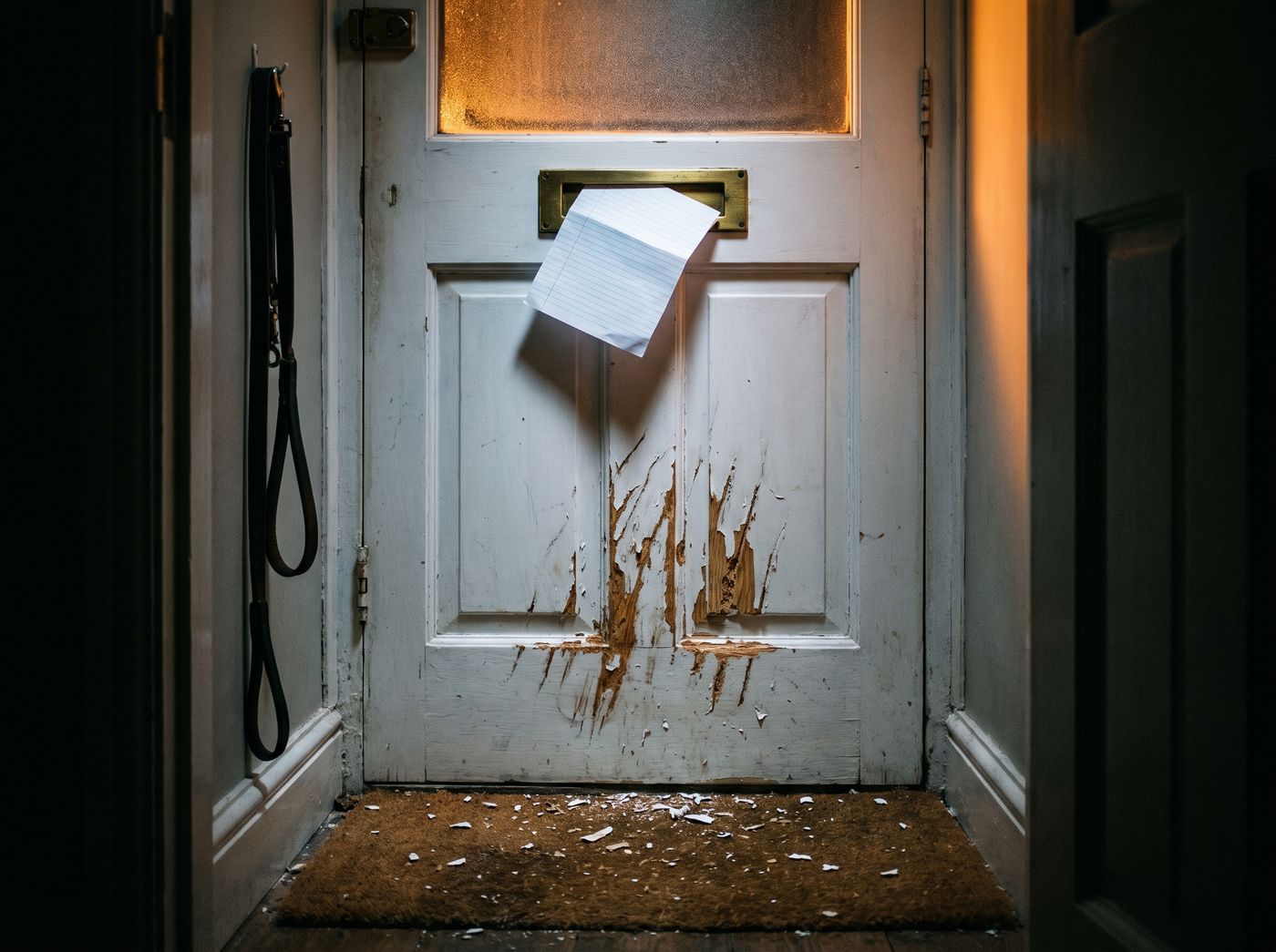
THE REAL ROOT CAUSE OF SEPARATION PANIC (THAT THEY'RE HIDING)
Let me break this down in terms anyone can understand.
Picture the smoke alarm in your hallway going off at 2 a.m. for no reason. You pull the battery, but the backup kicks in and it keeps screaming. You put a pillow over your head. You take a hammer to the speaker. The circuit is still live, still firing "FIRE".
The pillow over your head is the crate.
The hammer to the speaker is the bark collar.
The radio you left on? That's a birthday party in the same room as the screaming alarm.
That's the containment industry — stuffing pillows over sirens, breaking speakers, filming the chaos on a camera — while charging you £150 an hour.
Here's what the science now says:
1. "The Output Trap" — everything you've tried acts on the output.
The crate contains the body. The collar suppresses the bark. The Kong distracts the mouth. The medication dulls the brain. But the alarm that triggers all of it — the moment his brain registers "I am alone" and floods him with adrenaline for hours? Nothing you've tried touches that.
2. "The Countdown" — the alarm doesn't start when you leave. It starts before.
Shower, coffee, keys, shoes, coat. By the time you pick up your keys, he's been counting down for ten minutes. The crate, the Kong, the departure training all assume the panic begins when the door shuts. It doesn't. It began while you were still making coffee.
3. "The Rehearsal Effect" — every departure makes the next one worse.
This is the cruellest part. Every time he panics, his brain learns: "This is what we do when you leave." The alarm fires faster. The panic runs deeper. A dog who once whined at 30 minutes now howls at 5. "He'll get used to it" is exactly backwards.
4. "The Silent Half" — half of them suffer where you can't see it.
Remember the RSPCA figure: 8 out of 10 dogs find it hard to cope when left alone, and half show no obvious signs. No barking. No chewing. You come home to a quiet house and a dog who seems fine — after three hours frozen on the doormat. Silence is not calm. And an industry that sells bark collars has no interest in telling you that, because a silent dog doesn't generate complaints.
And here's the kicker:
Every puppy is born recognising one signal that stands the alarm down. It's the calming "all-clear" a nursing mother gives her litter when they're safe. Science reproduced it as a synthetic analogue decades ago. It reaches the alarm — the root cause — where crates and collars never can. They've known this for years.
This is the "Contain-the-Behaviour Playbook":
- Crate him
- he still panics, just with less room
- prescription for fluoxetine
- quieter but not calm
- book a behaviourist
- "keep doing the door thing"
- buy a bark collar
- he learns to suffer silently
- buy a camera
- now you can watch the silent suffering from work
- try the supermarket diffuser
- unplug it at night to save it
- the refill runs dry without you noticing
- the neighbour writes another note
- the landlord calls
- you're back where you started, minus another £4,860
It's genius, really.
If you're a sociopath.
THE SOLUTION HIDING IN PLAIN SIGHT
Remember Rachel standing in my consulting room, placing a spreadsheet of 214 departures on my desk — a neighbour who'd left a note and a landlord who'd given a final warning — and asking me the question I couldn't answer?
On Day 41, she went out for the first time in 11 months without dread. Her sister's 40th birthday dinner. Four hours away from the house.
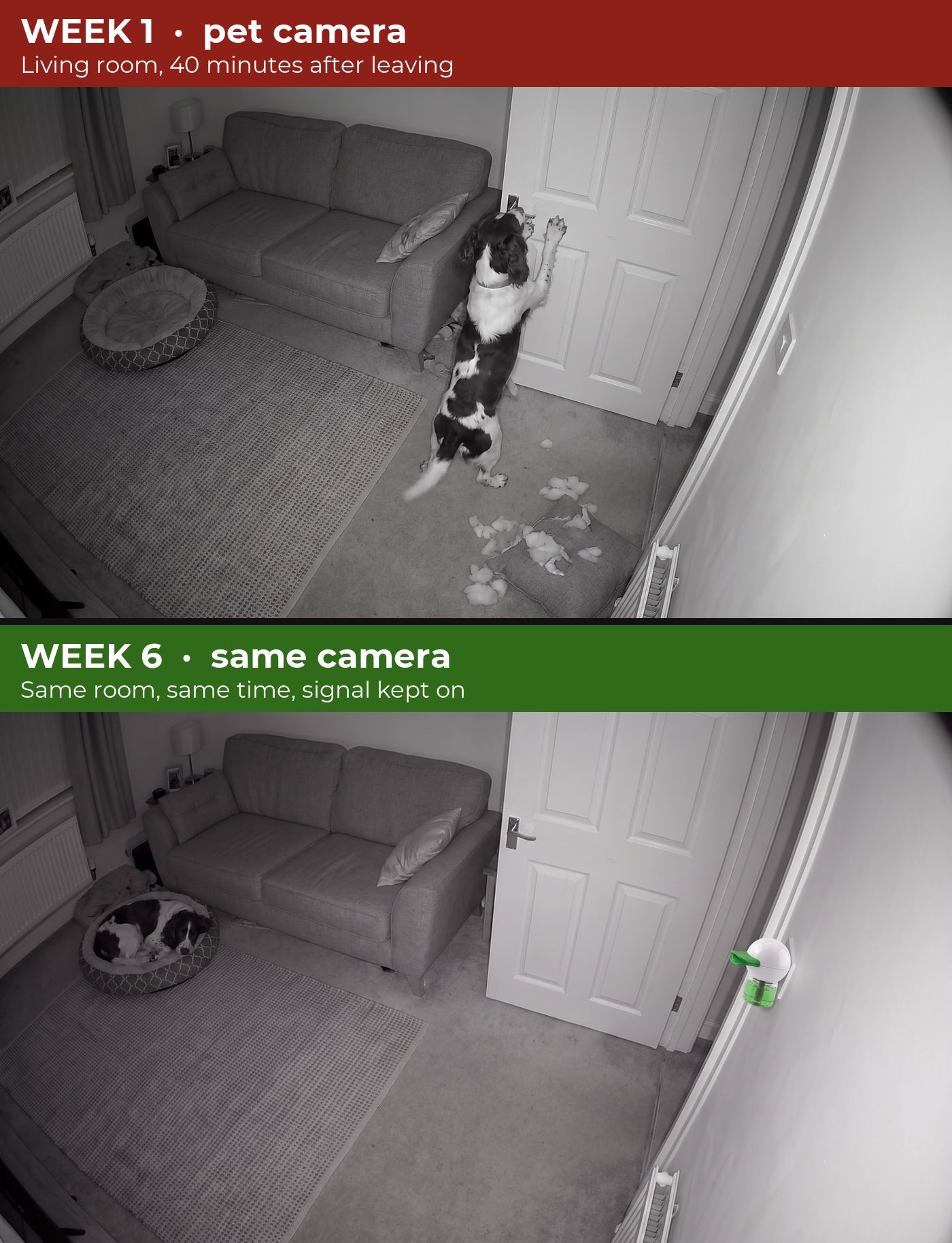
When she checked the camera from the restaurant — once, a quick glance during dessert — the footage showed Bramble curled on the sofa, head resting on his paws, the small light of the diffuser glowing in the corner of the room.
Seven short clips in four hours. The whole evening. When she first came to me, a single afternoon filled her phone with alerts.
The neighbour, the one who'd written the note, stopped Rachel on the drive the next morning. "I haven't heard him in weeks," she said. "Is he okay?"
Rachel nearly laughed. He was the most okay he'd been in four years.
No new behaviourist sessions booked. No tablets. No "keep going".
Just one thing, done differently from every other time she'd tried it.
To actually switch the alarm off — not just contain the noise — you need to do ONE thing: KEEP THE ALL-CLEAR SIGNAL ON, all day, every day, so the alarm never gets a chance to fire. You need something specifically designed to:
- Deliver the signal continuously, 24 hours a day — not a spray that fades in an hour, and not a tablet that wears off and leaves him panicking at 3 a.m.
- Fill the whole room he's left in — up to 70 square metres — because that's the territory his alarm monitors when you're gone.
- Be on BEFORE the countdown starts — days before, not the morning you leave.
- Never gap: the next refill must be in the socket before the last one runs dry, because the moment the signal drops, the panic circuit starts rebuilding itself.
And guess what?
The synthetic analogue of the mother's all-clear signal exists. Owners who kept it on without gaps describe the change in exactly the same words: "I accidentally let it run out and seen the difference straight away." Or, as another owner put it: "I really notice the difference whenever it runs out!"
So if the solution has been sitting in plain sight this whole time, why did every trainer, vet and behaviourist focus on containing the noise instead of switching off the alarm?
That's the question that led me somewhere the containment industry really doesn't want you to go.
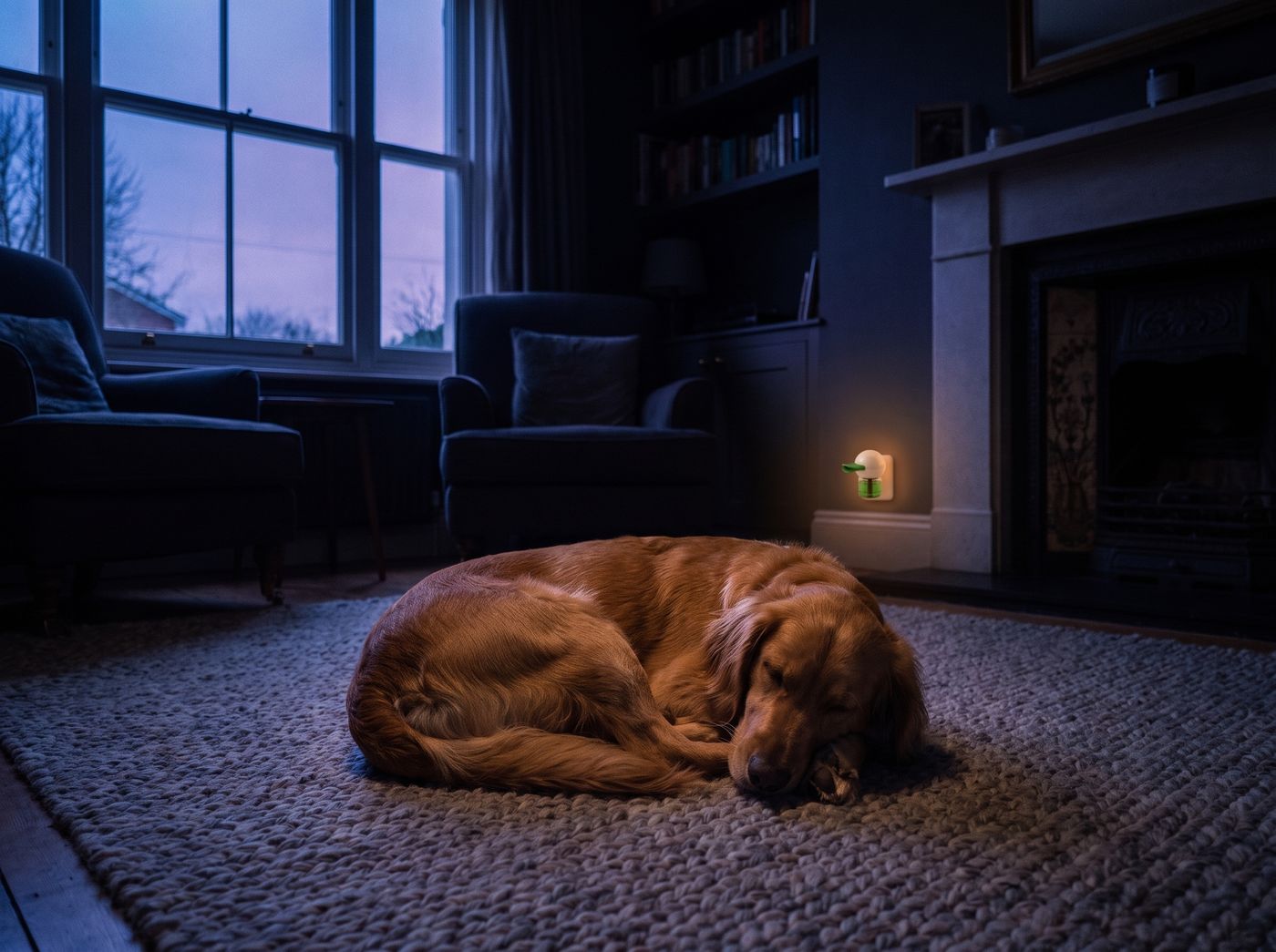
THIS BREAKTHROUGH IS UPSETTING AN ENTIRE INDUSTRY
After Rachel's results, word spread like wildfire.
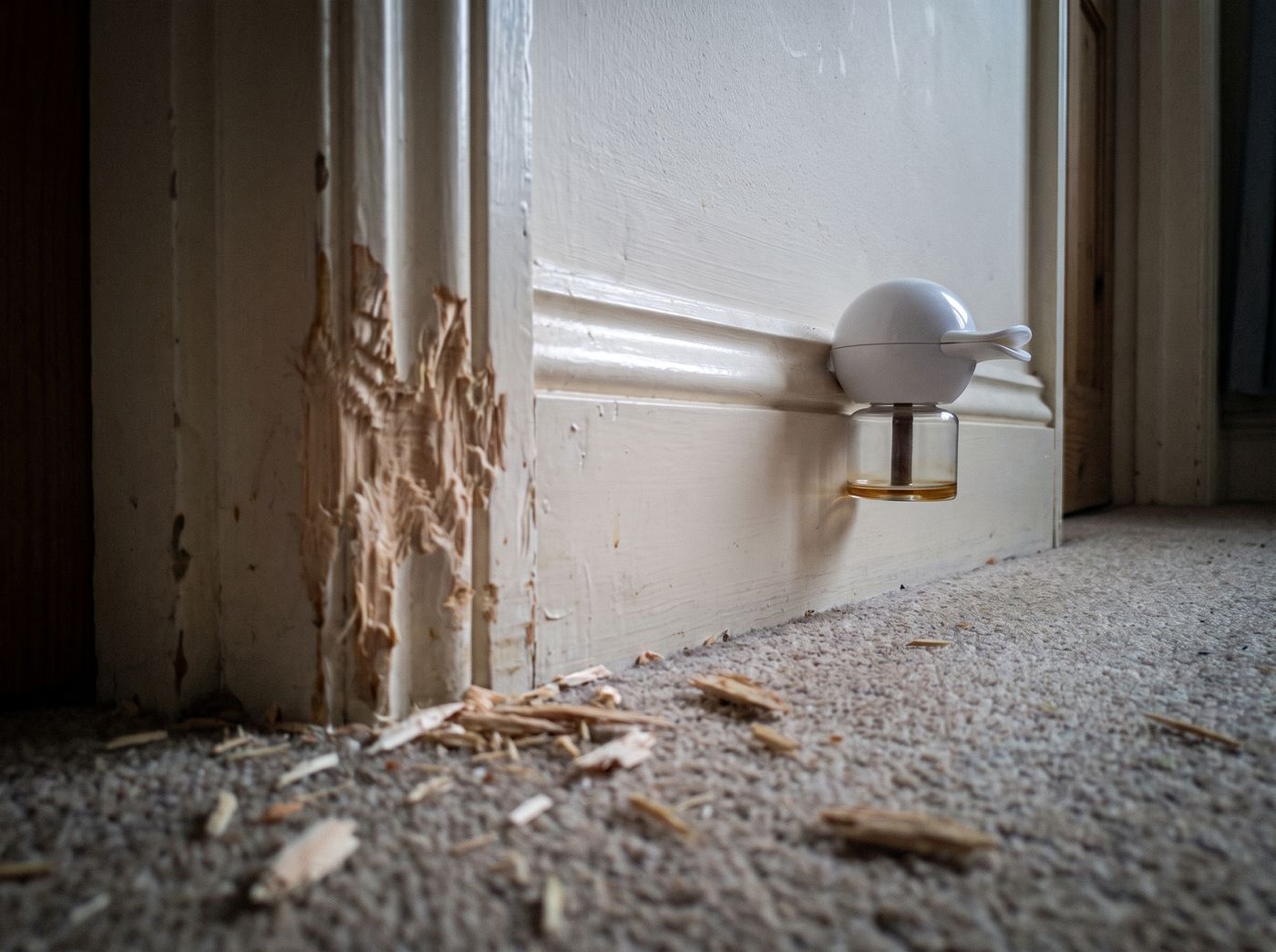
Margaret, a veterinary nurse on 12-hour shifts with a rescue lurcher who'd been passed between foster homes, knocked on the door of my consulting room. She held out her phone: a kitchen door frame chewed down to the bare wood. £640 in repairs, she'd been quoted.
"Ellie, whatever you gave Rachel. I'm at breaking point. He's been with me a year, and I can't leave him for longer than a trip to the loo."
I gave her the same protocol. Six weeks later, she sent me a camera still: the same lurcher, stretched out on the sofa, eyes closed, at 2:17 pm on a Thursday, while Margaret was three hours into a shift. The door frame was untouched.
Soon my inbox filled with stories.
A nurse on nights in Toronto, whose terrier-cross had triggered three noise complaints from the building, started leaving for work without the familiar knot of dread in her stomach.
A retired teacher in Brisbane, whose kelpie had howled so hard her neighbours had started keeping a bark diary, emailed to say the last follow-up call had ended with "We've had no further complaints."
A couple in Galway, who hadn't been out together for an evening in seven months, described their first dinner out — and a camera feed that showed a dog asleep for three straight hours.
A single dad in Christchurch, who'd received a warning letter from his landlord, messaged to say his last camera check, made from his desk at 10:30 am, showed his spaniel lying in a patch of sun on the mat.
And a 67-year-old in County Clare who'd quietly stopped going to her weekly bridge club because she couldn't bear the camera alerts — she started going again.
Every. Single. One. Got. Better.
Not "managed another absence" better.
Not "quieter on the trazodone" better.
Actually, measurably, life-changingly BETTER.
WHEN YOU MESS WITH THE CONTAINMENT INDUSTRY, THEY COME FOR YOU
James Harrington, head of behavioural medicine at a large training academy in the south of England (and someone I'd shared conference panels with for nine years), pulled me aside at a behaviour congress in Bristol.
"Eleanor, you need to be careful. What you're doing threatens the whole business model. The academies that charge £2,500 for a six-month separation programme. The people who sell the apps and the books. The companies that make bark collars. Three training academies are filing complaints already — they're saying you're undermining their methods. Stop now, while you still can."
I told him to go to hell.
And then the complaints came.
Funny how they never challenged the 49% rehoming-or-eviction rate in my own files.
Funny how they never disputed the £4,860 Rachel spent on their methods with no result.
Funny how they never addressed the 1 in 2 dogs who suffer in silence — the ones their bark collars have no answer for.
The final straw? My puppy-class sponsor — a crate manufacturer I'd partnered with for our clinic's socialisation programme — suddenly pulled their sponsorship.
"Sorry, Dr. Vance. Corporate decision. We can't be associated with 'anti-crate messaging'."
They wanted me gone because I'd stumbled onto something that made their entire business model obsolete. A solution that:
Switches off the alarm (not just muffles the noise while the dog suffers in silence)
Keeps the signal on for a full 30 days without a gap (not a refill that runs out on day 19 while you're at work)
Covers the whole room your dog is left in (not a tiny scent radius that stops at the door frame)
Works from the moment it's plugged in, days before you ever need to leave (not a tablet swallowed an hour before, leaving you with a zombie who still panics when it wears off)
But here's what they didn't count on...
I'd already partnered with an independent formulation lab that believed in the mission.
We'd run a home trial with 212 dogs who'd failed crate training, medication and multiple behaviourist interventions.
And we'd turned the protocol into something even more powerful.
THE PLUG-IN DIFFUSER THAT'S MAKING THE CRATE-AND-COLLAR CROWD NERVOUS
It's called Vitalys Calma.
It's not the supermarket plug-in you forgot to refill. It's not a scented oil that masks the panic. It's not a sedative that changes his personality.
It's built to meet the four requirements every failed solution ignored. Every component has a job, and every job maps directly onto the alarm.
Here's what makes it different:
- The All-Clear Signal — Vitalys Calma contains a synthetic analogue of the mother dog's appeasing signal, at a concentration of 2%. It's the message a puppy reads as "all clear: nothing to worry about." It's odourless to people — no floral scent, no potpourri. It isn't a drug. It doesn't sedate him. He's still him. He'll still bark at the postman and chase squirrels. But the panic that fires when the door closes? That's what the signal stands down.
- The Room Guardian — The diffuser gives off a gentle, constant warmth that spreads the signal through a space of up to 70 square metres — a whole open-plan living room, not just the corner by the door. The plug is supplied to fit your country. No wiring. No batteries. No app.
- The Constant — Each refill gives 30 days of continuous diffusion. Thirty days without a single moment where the signal drops and the old panic starts rebuilding.
- The Safety Net — On the subscription, the next refills arrive at your door before the old ones run dry. Pause or cancel anytime. It's the only way to make sure he never spends a single day without the signal again.
Here's what most people don't understand about separation anxiety — and what I wish someone had told Rachel on Day 1:
The alarm is not an enemy you defeat once. It's a permanent resident in your dog's brain. You cannot train it away permanently — the 49% figure from my own files proves it. You cannot drug it away permanently — the panic that returns the moment the tablet wears off proves it.
What you CAN do — the only thing that actually works long-term — is keep the all-clear signal on continuously, so the alarm stays quiet, the rehearsal stops, and your dog finally learns what it feels like to be alone without panic.
Think of it like blood pressure medication. You don't take it for 90 days, see your numbers improve, and then stop. Your numbers improved BECAUSE you're taking it. Stop, and they climb right back.
Vitalys Calma works the same way. He's calmer BECAUSE the signal is telling his brain "safe." Stop the signal, and the alarm starts to wake up — not because the product "stopped working," but because the alarm never left.
This isn't a flaw. It's the reason it works so much better than one-off interventions. A bark collar is a correction followed by 364 days of an untouched alarm. Vitalys Calma is 365 days of "all-clear, all day."
Here's the timeline most owners experience:
Days 1–14: The Build-Up Phase
The signal builds up in the room. You may not see a dramatic change yet, but the countdown that used to start when you picked up your keys begins to shorten.
Days 15–30: The Settling Phase
The camera shows longer stretches of calm — a dog who lies down after two minutes of pacing, instead of pacing for the full hour. When you step out for a quick errand, the alerts on your phone drop from dozens to single digits.
Days 30–90: The Trust Phase
This is where the real change takes root. For the first time in months or years, his brain is learning that absences don't hurt. The panic that fired every time the door shut is no longer being rehearsed. Bramble, on Day 41, gave Rachel seven short clips in a four-hour evening. The neighbour noticed the silence.
After 3–6 months of consistent use:
The camera shows a dog who sleeps while you're at the supermarket. The neighbour who left the note waves at you on the drive. The guilt that sat in your chest every time you picked up your keys? Smaller. A whisper, not a scream.
Month 6+: The Maintenance Phase (This Is Where Most Owners Stay)
Your dog is calmer. The alarm is quiet. And every owner in this phase understands the same thing: the moment you stop, the signal drops, and the old panic can start firing again. Not in months. In weeks.
That's why most of our customers choose the subscription. Not because we lock them in — because after a quiet house and a calm dog for the first time in years, they never want to go back to checking their phone in the supermarket queue. The refill arrives before the old one runs out. They never have to think about it.
THE RESULTS THAT HAVE BEHAVIOURISTS SECRETLY ORDERING FOR THEIR OWN DOGS
In the last 18 months, over 6,400 owners with dogs showing separation distress have used the full Vitalys Calma protocol.
The numbers from my clinic's follow-up survey of the 212 trial dogs:
But here's the statistic that matters most to me:
Our return rate: 0.8%.
That's 8 people out of 1,000. And most of those were situations where the diffuser was plugged into the wrong room, or a refill was missed at week 6.
Check out what real owners with verified purchases are saying:
"I was the woman with the spreadsheet. 214 departures, 63 clips, the 21-second silence that broke my heart. I'd spent £4,860 on crates and apps and sessions and tablets and a plug-in I forgot to refill. My landlord's letter said one more complaint and we'd lose the tenancy. On Day 41, I went to my sister's 40th. Four hours. I checked the camera once — he was curled on the sofa, breathing slow. Not howling. Not pacing. The neighbour stopped me the next morning to say she hadn't heard him in weeks. I haven't added a new line to the spreadsheet in eight months. That's my life back."
"I have a kelpie who screamed the place down from the moment I shut the front door. The neighbours were keeping a bark diary and a formal complaint had gone in. I'd tried a plug-in from the pet shop before — it ran out when I wasn't looking and I never noticed a change. The Vitalys kit arrived in 6 days. I plugged it in the living room and let it run. Week 3, the camera showed her standing at the door for ten minutes, then lying down. By week 6, she was asleep. The follow-up call came to say there had been no further complaints. I cried on the kitchen floor."
"I'm a nurse on night shifts, and my terrier-cross triggered three complaints from the building in six months. I'd spent thousands on a behaviourist, trazodone that turned him into a zombie, and a crate he chewed through. I was one complaint away from having to rehome him, and the thought made me physically ill. I plugged the Vitalys diffuser in on a Thursday and didn't expect much. In week three, I left for a shift and didn't check my phone for the first hour. When I did, the camera showed him curled on the back of the sofa, blinking. No barking. No howling. That was nine months ago. I'm on subscription. I never want to run out."
THE PRICE THAT'S CAUSING TRAINING-INDUSTRY PANIC
Let me show you what "managing" separation anxiety REALLY costs (with receipts):
The Behaviourist Route:
- Behaviourist sessions: £150/hour × 8 sessions = £1,200
- Graduated-departure app: £90 + £19/month × 6 months = £204
- Camera: £38
- Annual total: £1,442 (for a protocol that still leaves 49% of dogs in my files rehomed or facing eviction)
The Medication Route:
- Vet consults: €50,93 × 4 visits = £180
- Fluoxetine: £95/month × 12 = £1,140
- Trazodone: £42/month × 12 = £504
- Annual total: £1,824 (for a dog who is "manageable" but still panics when the dose wears off — and who is "not himself")
The "Containment" Route (What Most Owners Actually Do):
- Crate: £120
- Bark collar: £47
- Camera: £38
- Dog sitter at £80/day × 50 days = £4,000
- Calming chews: £22/month × 12 = £264
- Lost evenings, the note on the door, the landlord's letter: priceless misery
- Total: £4,469+ (for a system that never once touches the alarm)
Now here's the maths that should make you furious.
You're paying £1,400–£4,500 a year — up to £375 a month — for containment that leaves the alarm completely untouched.
Vitalys Calma on subscription costs €50,93 per delivery for Kit 2 (two diffusers and four refills — two rooms continuously covered for 60 days, with the diffusers free). That's €0,85 a day. To keep the all-clear signal on, uninterrupted, where he needs it most.
The containment industry LOVES the current model.
Know why? Recurring revenue.
You're not a pet owner — you're an annuity. A repeat prescription every month, a behaviourist every few weeks, a new camera subscription, a new chew, a new collar. A lifetime of managing a symptom while the root cause fires away untouched.
But here's what really terrifies them...
Kit 2 should cost €127,90. That's what a comparable calming pack costs at a referral behaviour clinic.
But I didn't create this to profit from the fear that lives between your front door and your neighbour's letterbox.
I created it because I watched Rachel place a spreadsheet on my desk — 214 departures, 63 clips, £4,860 spent — and ask me a question I couldn't answer.
So here's the deal:
The regular price for Kit 2 is €127,90.
Already less than ONE behaviourist session.
But that's not what you'll pay today.
THE 60% OFF "MIDDLE FINGER" TO THE CONTAINMENT INDUSTRY
Remember that crate manufacturer who pulled their sponsorship from my puppy classes?
Last week I found out that three training academies have now filed formal complaints about my protocol, trying to have it labelled "misleading".
They can't copy it (the formulation specs are locked down with the independent lab).
They can't buy me out (I told their representatives exactly where they could put their offer).
So now they're trying to discredit me in my own profession.
My response?
For the next 72 hours only, I'm releasing Kit 2 at 60% OFF.
That's right.
€127,90 → €50,93 on subscription
The same two diffusers and four refills that kept Bramble calm while Rachel went to her sister's 40th — for:
Less than ONE behaviourist session (£150).
Less than ONE month of fluoxetine (£95).
Less than a single day of a dog sitter (£80).
Why would I practically give these away?
Because every owner who checks their camera to find a sleeping dog, instead of 60 alerts of panic, is living proof the containment model is broken.
Because I want results flooding owner forums before the training academies can silence us.
Because sometimes the best revenge against an industry that sells you a £4,860 bill of goods is to give away the solution for €0,85 a day.
Check availability →⚠️ BUT HERE'S THE BRUTAL REALITY
This 60% discount expires in exactly 72 hours.
Not a marketing gimmick. Defending these complaints isn't cheap.
After 72 hours, we return to €127,90 per kit.
Also — and this is critical — we only have 1,847 kits remaining at this price.
Our formulation lab can only produce 300 kits a week while keeping the exact 2% concentration of the analogue.
Last month, after a podcast feature on separation anxiety, we sold out in 9 hours.
That's why we pulled out of Amazon — too many knock-off "calming diffusers" with lavender oil and zero analogue flooded in when we sold out. The ONLY place to get authentic Vitalys Calma, with the correct 2% formula and the plug for your country, is through this page.
If you're reading this, kits are still available.
But we're currently selling 42 an hour.
Do the maths.
MY PERSONAL 90-NIGHT "QUIET HOUSE" GUARANTEE
Look, I get it.
You've been burned before. Crates, collars, sessions and tablets that contained the noise while the alarm kept firing underneath. Promises of "he'll get used to it" that delivered another note, another complaint, another morning crying in the car.
So here's my promise — and I'm putting it in writing:
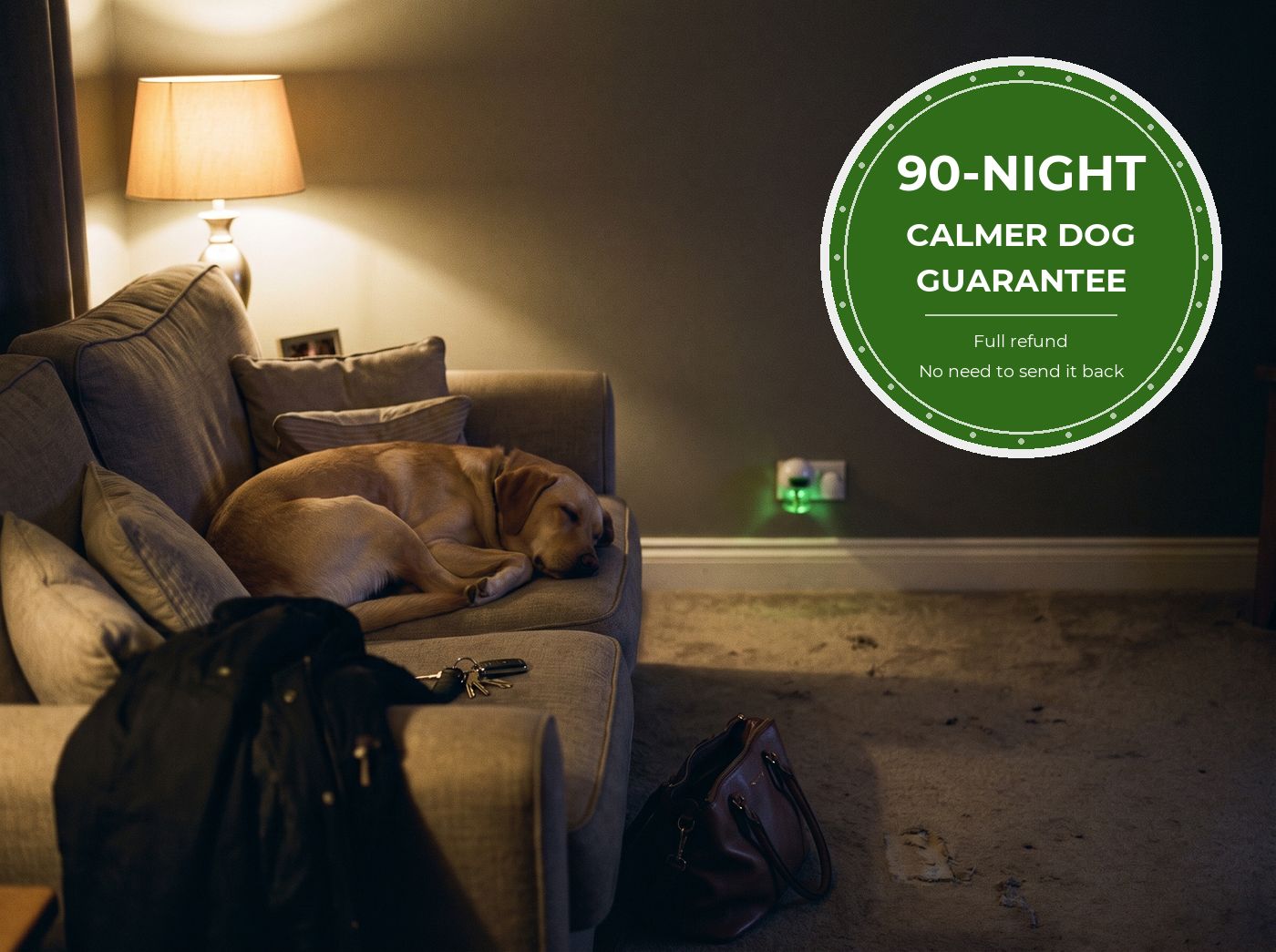
Try Vitalys Calma for 90 full nights.
Plug the diffuser into the room where your dog spends his time when you're out. Leave it on. Don't unplug it. Let each refill run its full 30 days, and let the next one arrive before the last runs dry.
Notice the camera clips. Pay attention to what your neighbour says. Or what they stop saying.
And if after 90 nights your dog isn't calmer — less barking when you leave, less destruction, calmer nights — write to us and we refund the complete kit.
No forms. No questions. No need to send anything back.
Why am I this confident? Because in 18 months and over 6,400 owners, our refund rate is 0.8%. Most of those had plugged the diffuser into a room too far from where the dog spends his day.
Check availability →THE DECISION THAT WILL DEFINE YOUR NEXT DECADE WITH HIM
Right now, you're standing at a fork in the road.
Path #1: Keep Doing What You're Doing.
Keep shutting him in with your hand shaking on the door handle.
Keep listening for the note dropping through your letterbox, the landlord's phone call, the sound of your own voice rehearsing what you'll say when someone finally asks, "Is he really okay in there all day?"
Keep checking the camera at work, at the shops, at a family do — and seeing the same thing: him standing at the door, head up, mouth open, frozen.
In a year, you'll be reading these words again, on a different website, and the only thing that will have changed is another 365 days of rehearsal making his alarm louder.
Path #2: Switch Off the Alarm.
Spend less than one behaviourist session.
Get the protocol that's helped 6,400+ owners finally leave the house without the dread.
Go out for dinner and check your phone once, instead of fifty times.
Come home to a dog curled in his bed and a door frame that needs no repair.
Hear your neighbour say, "I haven't heard him in weeks."
I think you know which path leads to your first quiet homecoming.
HERE'S EXACTLY WHAT HAPPENS NEXT
Step 1: Click the button below that says "Check availability".
Step 2: Choose your plan (Flash Sale — ends in 72 hours):
→ SUBSCRIBE & SAVE — THE SMART CHOICE (78% of owners choose this)
Separation panic is a chronic condition: without the all-clear signal, the alarm starts rebuilding within weeks. On Subscribe & Save you get 25% off every delivery, the diffusers FREE, and shipments timed so you never have a gap. Pause or cancel anytime.
KIT 1 — "One Room": 1 diffuser + 2 refills (60 days, 1 room). €29,93 per delivery on subscription. (One-time purchase €39,90; regular price €63,90.)
KIT 2 — MOST POPULAR: "Two Rooms": 2 diffusers + 4 refills (60 days, 2 rooms). €50,93 per delivery on subscription. (One-time purchase €67,90; regular price €127,90.) It covers the two spaces most dogs monitor: the main living area and the hallway.
KIT 3 — BEST VALUE: "The Whole-House Protocol": 3 diffusers + 6 refills (60 days, 3 rooms). €65,93 per delivery on subscription. (One-time purchase €87,90; regular price €191,90.) The protocol from my clinic for multi-room homes: living room, hallway and bedroom, so the all-clear signal follows him wherever he goes.
Step 3: Enter your shipping details. Tracked delivery in 5–7 working days to the UK, Ireland, Australia, New Zealand and Canada.
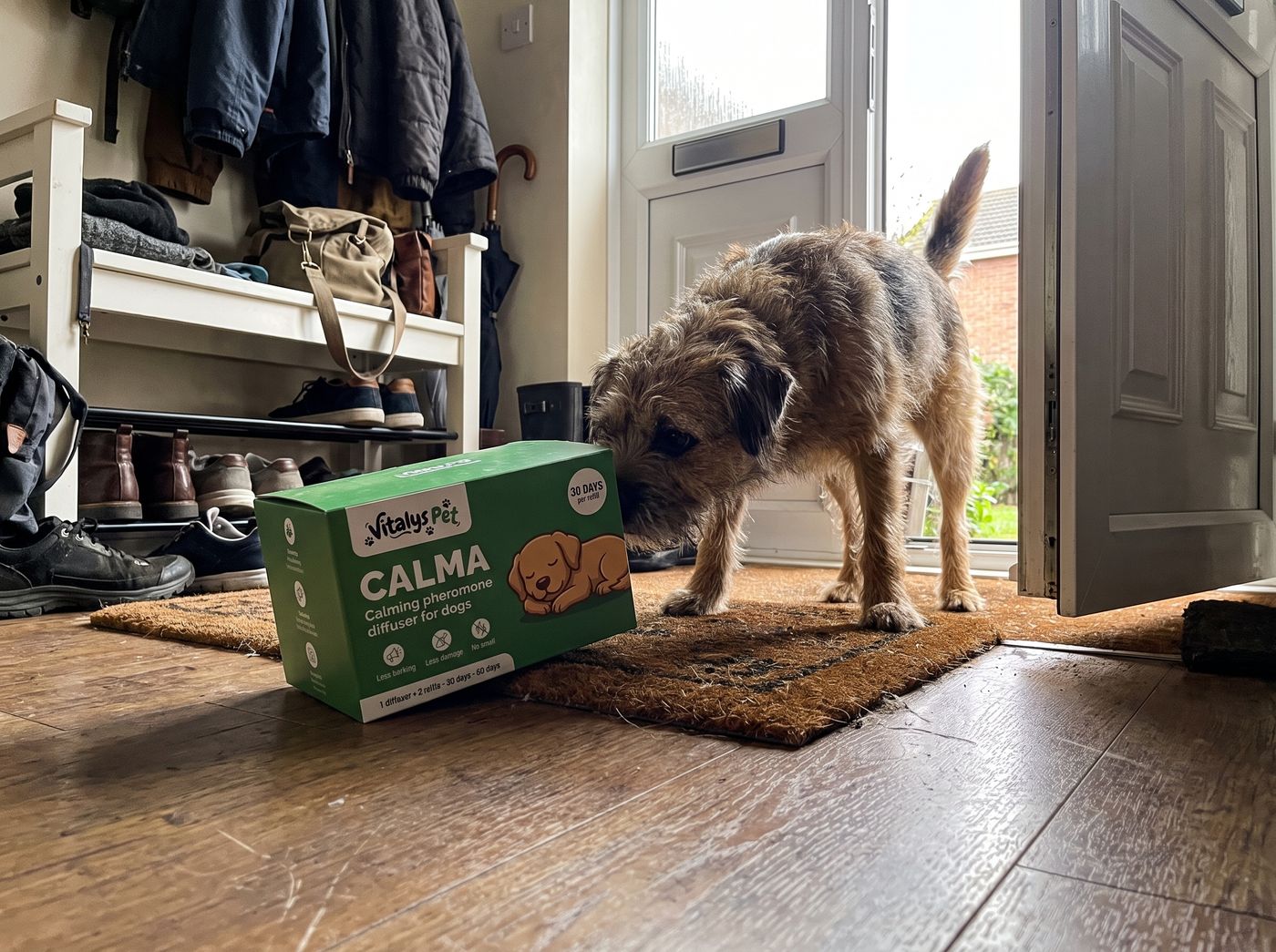
Step 4: Plug it in the day it arrives, in the room where he spends his time when you're out. Don't wait until the morning you leave. The signal needs to be on before the next departure.
Step 5: Leave it on. Don't unplug it at night. When the subscription refills arrive, swap them in before the old ones run dry.
Step 6: Write and tell us about your first quiet homecoming — just reply to your order confirmation. I read every one. They keep me going when my own profession sends complaints.
But whatever you do, don't close this page thinking "maybe later."
There is no later when you're living between notes from the neighbour.
"Later" is another week of listening for the crunch of tyres on the drive, knowing the alarm is already building.
"Later" is another camera clip of him standing at the door, alone, heart hammering, while you're stuck in a meeting.
"Later" is the landlord's letter — the one that says "final warning" — slipping through your letterbox because you waited one more week.
"Later" is this discount expiring, and his alarm getting another year to rehearse.
Your dog has been stuck on alert long enough.
Your next quiet homecoming has waited long enough.
Check availability →Dr. Eleanor Vance
Veterinary Behaviourist, 22 Years in Practice
Creator, The Four-Room Departure Protocol
Enemy #1 of the Containment Industry
P.S. — Rachel sent me an update last week: a weekend away with a friend, booked six months in advance. "The neighbour had a key to check on him — they're friends now, she offered — and I sat in a café in Bakewell and didn't check the camera once. The last entry on the spreadsheet is dated six weeks ago: 'No data. Not needed.'" The woman with 63 panic clips and a landlord's letter gave me permission to quote her. That could be you. But only if you act.
P.P.S. — I'm looking at our inventory right now. We're at 1,847 kits, selling 42 an hour. By the time you read this? Could be under 1,000. When we hit 500, this page comes down. You've been warned.
Check availability →P.P.P.S. — If you're a crate manufacturer, a bark-collar seller, or a trainer who charges £2,500 for a separation programme and wants to challenge me: bring it on. I have 6,400+ owners, follow-up data from 212 dogs, and a spreadsheet from a woman called Rachel who spent £4,860 on your methods with no result. You know it. I know it. Their owners deserve to know it too.
P.P.P.P.S. — The #1 mistake I see new owners make: they see fewer camera alerts around week 6–8 and think, "Maybe he's cured. Maybe I can skip this month's refill." Within 10 days, the signal drops and the alarm starts waking up. Please don't stop once his camera feed looks calmer. That's like stopping blood pressure medication because your numbers improved. Your numbers improved because of the signal. Subscribe. Stay protected.
Check availability →