“Like He Was Being Murdered”: What Your Dog Does 5 Minutes After You Leave — and the Puppyhood Signal That's Switching It Off
The crate, the bark collar, the camera, the Kong, the trainer, even the vet's tablets: each one quiets the noise for a while — and not one of them tells your dog he's safe. After reading 11,106 stories from owners who had tried everything, a veterinary behaviourist found the one thing every one of them was missing — and why the owners who finally got their evenings back never had to choose between their dog and their life.
 Written by Dr. Eleanor Vance, Veterinary Behaviourist, 20+ Years in Practice
Here's a number that should stop you cold.
Research suggests that 8 out of 10 dogs find it hard to cope when left alone. Yet half won't show any obvious signs.
Let that land.
Think of the dog down the road. The one you never hear a peep from.
He might be in pieces.
There is a silence behind some doors that is not calm. It is shutdown. A dog who has learned that nobody comes, no matter what sound he makes.
And if you think that's better — it's not.
It's worse.
So which one is yours?
The one who howls the moment your car pulls away? The howl your neighbour later describes as "like he was being murdered"?
Or the one who shows nothing at all? No noise. No damage. Just a dog trembling behind the sofa for three hours.
He meets you at the door with a frantic, tongue-lolling relief. It looks like joy. It's actually the aftershock of a panic attack.
You might not know.
That's the unbearable part.
You cannot see what happens after the door closes. Nobody can. You get fragments: a barking alert on your phone. A neighbour's hesitant text. A puddle on the hallway floor.
But the full picture? The minutes stacked on minutes of blind, unreachable terror?
You never get that.
Not until someone tells you.
Not until the note arrives.
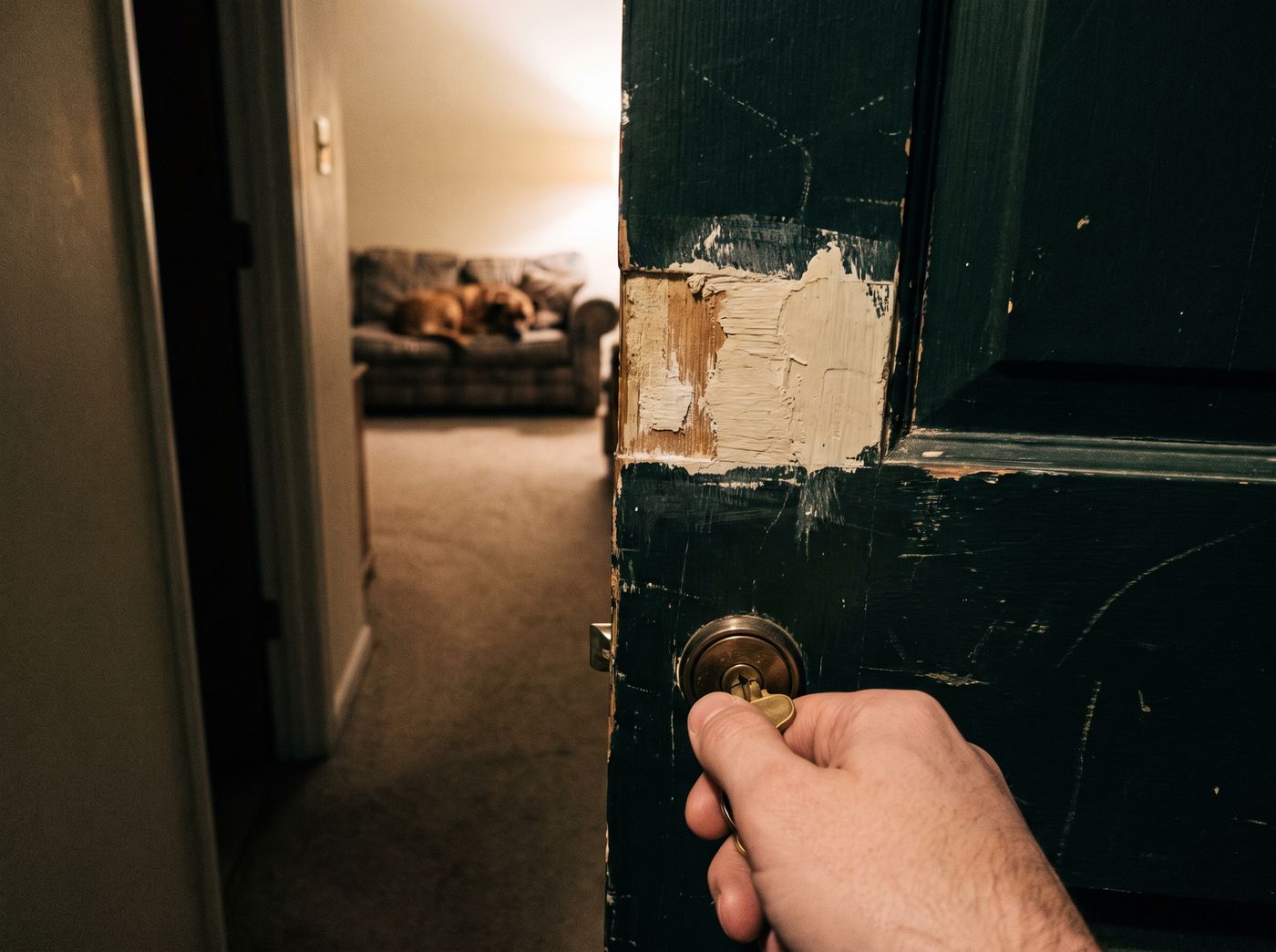
Meanwhile, you've tried everything. The crate. The radio. The Kong. The "just ignore him when you come back."
And one question has never been answered:
"What is he going through right now?"
If that question lives in your head — keep reading.
My name is Dr. Eleanor Vance. I've spent over twenty years as a veterinary behaviourist.

I've treated thousands of dogs across the UK, Ireland, Australia, New Zealand and Canada. I've seen separation anxiety in every breed, every age, every home setup you can imagine.
But I wanted to go further than my own clinic.
So I spent six months reading 11,106 comments and reviews from owners in your exact shoes. On Reddit, Mumsnet, DogForum, PetForums, TikTok, YouTube and Amazon — the places people go when the professionals have let them down.
What I found explains why nothing you've tried has worked.
And it explains the one thing the owners who finally got their lives back all understood. The thing nobody has told you.
THE NIGHT EVERYTHING CHANGED
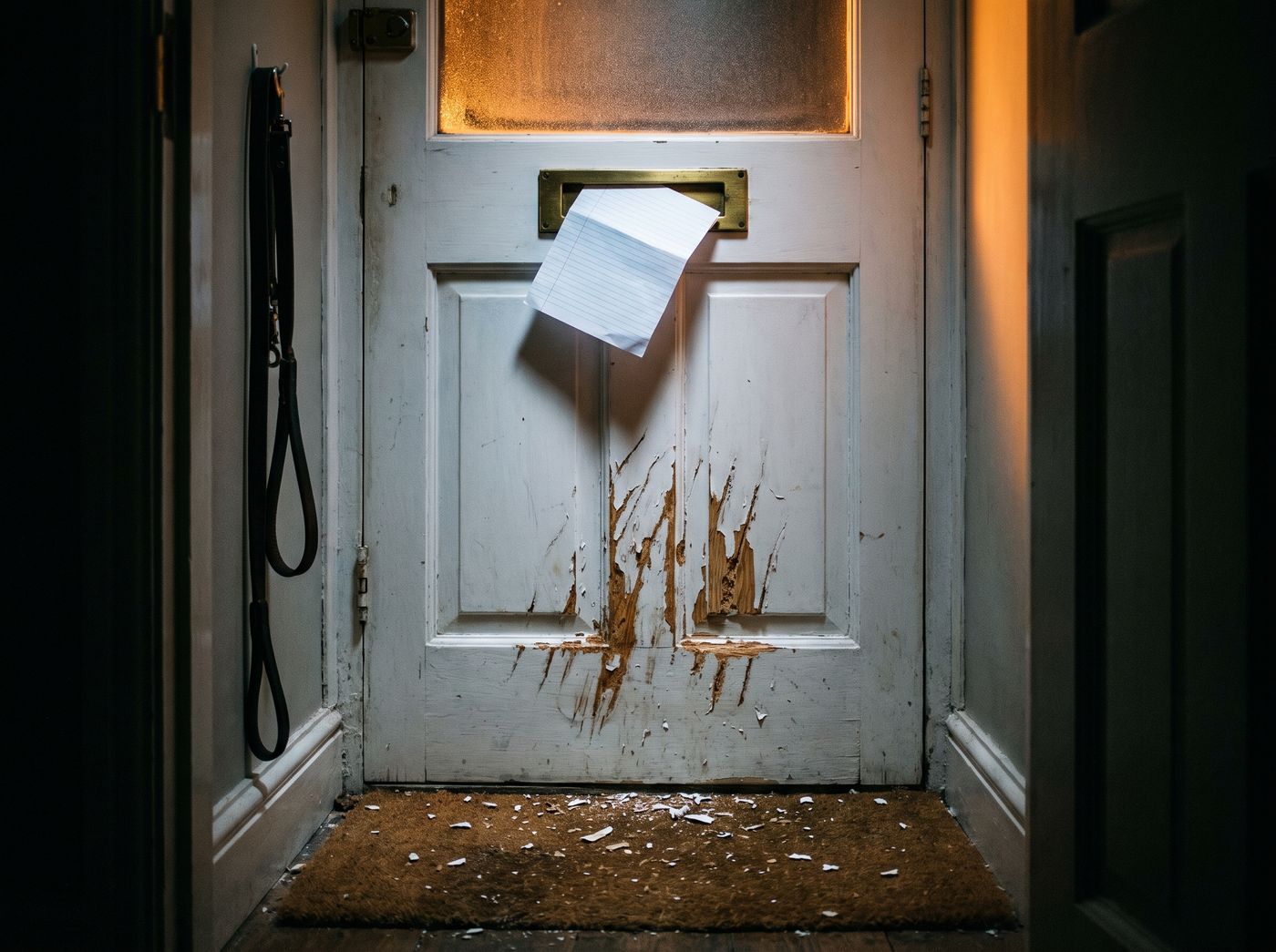
It started with an email.
9:07 pm, on a Tuesday. A woman I'll call Claire. She had attached a photo of a handwritten note, pushed through her front door that evening.
It said:
"You left your dog home alone for several hours and it barked the whole time. This is a noise nuisance in the neighbourhood. If it doesn't stop, we'll file a formal complaint."
She had been gone forty minutes.
Forty minutes. Picking up milk and bread.
She'd left the radio on. She'd given him a frozen Kong. She'd walked him for an hour before she went.
She came home to a note that made her feel like a criminal. And a dog so worked up he couldn't settle for hours.
I stared at that photo for a long time.
Because I knew what came next.
I've sat in consulting rooms with owners holding that note. I've seen the shame. The panic. And underneath it all, a quiet, desperate love for a dog they would do anything for — if only they knew what to do.
Maybe your story looks like Claire's.
Maybe you've tried everything the internet, the vet and the well-meaning neighbour suggested. And you're still exactly where you started. Only more exhausted. And more broke.
Here's the list so many owners I've worked with have been through. Count how many you've ticked off.
The crate. You were told it would be his "safe space." His den.
You spent weeks building it up: treats, meals, the softest bed you could find.
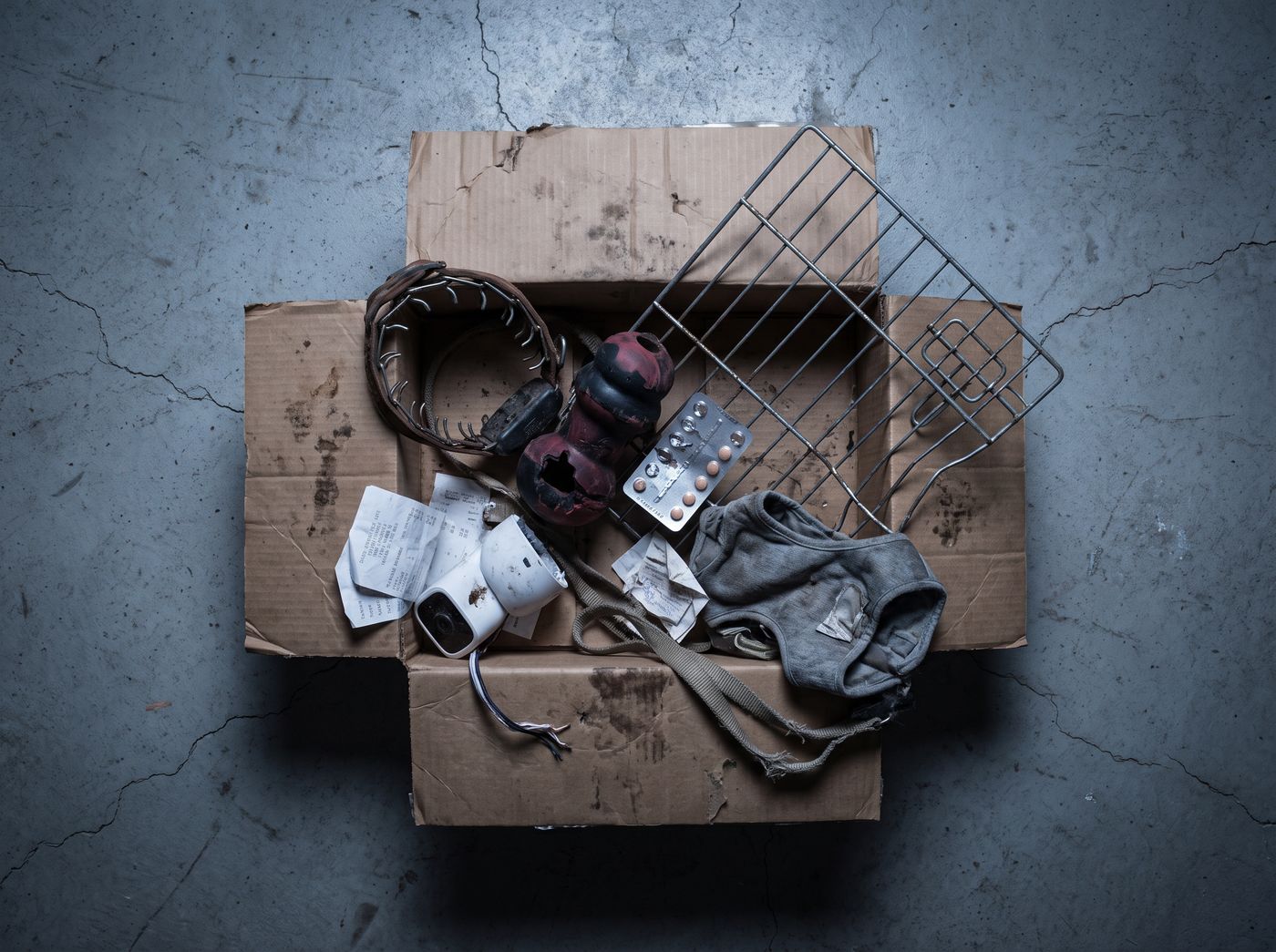
Then you left him in it for an hour. You came back to chewed bars and bleeding gums.
Because a dog in a panic attack doesn't feel safe in a crate. He feels trapped.
You contained the destruction. The price: his mouth, his trust, and the sound of a dog screaming in a metal box.
The bark collar. Citronella spray. Vibration. Or, if you were desperate enough, the one that delivers a shock.
You hated yourself for buying it.
And it worked. For about three days.
Then he learned to bark through it. Or he stopped barking and started chewing the wall instead.
Or — and this one still wakes me up at night — he learned to suffer in complete silence.
Imagine having a panic attack with tape over your mouth.
That's what you paid for.
The camera. You bought the pet camera. So you could watch him fall apart in real time.
In a meeting. In the supermarket queue. At your own mother's birthday lunch. Your phone screen filling with barking alerts.
Sixty notifications in an hour.
Every single one was your dog. Alone. Terrified. You could see him, but you couldn't touch him.
The camera didn't calm him. It just made you a spectator to his pain.
The Kong, the radio, the TV. You stuff the Kong with peanut butter and treats and feel a little flicker of hope.
He doesn't touch it until you walk back in the door.
The radio plays Bake Off to an empty room while he paces and howls.
And people say, "Just leave the TV on, it'll be fine." You want to scream, because they have no idea.
As one owner put it: "So many people suggest we leave the TV on for her or something — as though that's going to help when she's howling the house down."
Exercise. "Tire him out." So you get up at 5 am and run him for an hour before work.
He comes home. Drinks half a bowl of water. And the moment you touch your car keys, his adrenal glands fire like a switch.
A tired dog with a flooded system is still a panicking dog.
He just collapses faster afterwards.
The trainer. The behaviourist. £150 an hour. The one who tells you, with a straight face, that you cannot leave your dog alone. Not even for five minutes. For the next four to six months.
Who prescribes "door is a bore" and "sub-threshold training": standing up and sitting down next to the front door thousands of times, never quite leaving.
Meanwhile your boss calls to ask where you are. Your partner asks when you're coming back to bed.
And your life shrinks to the size of your hallway.
The app. £90 plus £19 a month. Julie Naismith's programme. "Be Right Back." It promises you'll get there if you just follow the method.
But the method demands you never leave your dog over threshold. And his threshold is the front door closing.
So you're trapped in the house with the dog you're trying to teach to be apart from you.
As one owner said: "In so, so, so many of the so-called 'success stories', the dog also started medication."
The vet's tablets. Fluoxetine at £95 a month. Trazodone at £42 a month. Separation medication generally "upwards of £100 a month."
You tried them because you were told they were the only thing left. Maybe they took the edge off.
But then came the words owners use again and again: "I don't like seeing a zombie."
"It completely knocks her out for hours, making her seem drunk, so we stopped using that."
And the worst one: "He's just not himself."
You saved his life and lost him in the process.
Nothing broke the cycle.
The experts weren't any better. You paid hundreds. Thousands. And they gave you a system that demanded what you couldn't give: time you didn't have, absences you couldn't take.
And all the while, your life was shrinking.
You stopped going out together. You couldn't nip to the shop without a military operation. You couldn't take the rubbish out without putting him on a lead.
You turned down invitations. The drink at the neighbour's. Lunch with friends. The wedding you really wanted to attend.
You started to feel what so many owners have told me they feel: "a prisoner in my own home."
Your partner said, "It's the dog or me." You knew they weren't joking.
Your landlord's last message said: "One more complaint and it's an eviction notice."
And then, in the quietest moment — the one you've never said out loud — you thought about rehoming him.
You imagined putting his lead in a stranger's hand.
The shame of that thought was worse than the panic itself.
That night, after reading Claire's email, something inside me snapped.
I wasn't going to watch another owner stand in my consulting room with a handwritten note in her hand. Having tried everything the professional world told her to try. And still without an answer.
I was going to figure this out.
Or die trying.
THE MIND-BLOWING DISCOVERY
For the next six months, I did something no researcher had done before.
I didn't go to the studies or the clinical trials. I went to the raw, unfiltered places where desperate owners type at 2 a.m. because they can't sleep.
11,106 comments and reviews. From the UK, Ireland, Australia, New Zealand and Canada.
Reddit threads from someone who'd just received a noise complaint. Mumsnet posts from mothers going back to work after maternity leave. Amazon reviews of every product that promised to help. YouTube comments under separation anxiety videos. TikTok confessions that were gone 24 hours later.
I read about the woman who set up her iPad to record her dog while she was out for two hours.
The longest her dog went without barking or whining?
21 seconds.
"It broke my heart," she wrote.
I read about the man who came out of a meeting to eight barking notifications, and felt his stomach drop.
I read about the couple who felt "trapped in our home" and admitted it was "starting to affect our relationship with the dog as it's so hard not to feel resentful."
And the more I read, the clearer the pattern became.
So obvious I couldn't believe I hadn't seen it before.
The whole "fix the behaviour" world is aimed at the wrong target.
The barking. The howling. The destruction. The puddle on the floor. The trembling behind the sofa.
They are not five problems.
They are five outputs of ONE thing.
They're treating the noise.
And the panic is the problem.
THE REAL ROOT CAUSE (THAT THEY'RE HIDING)
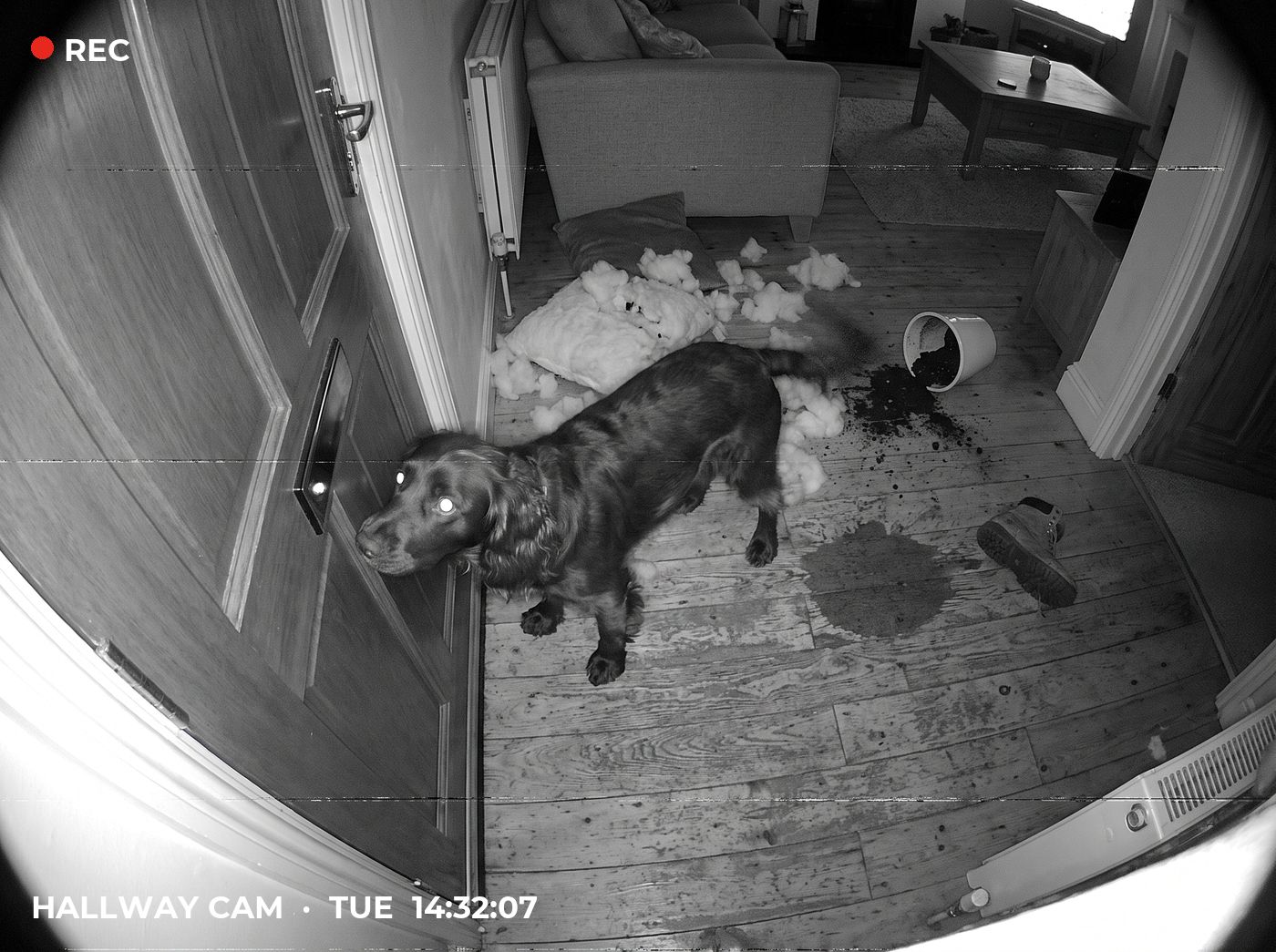
Let me give you an analogy.
Imagine a smoke alarm that's stuck on. It's been ringing for hours. There's no fire — the sensor is faulty, and it can't switch itself off.
The noise is unbearable.
So you try to stop the noise.
You put a pillow over it. That's the crate.
You cut the speaker wire. That's the bark collar.
You install CCTV so you can watch the alarm from your phone. That's the camera.
You throw a party next to it, with music and food and toys, hoping to drown it out. That's the Kong and the radio.
For a few minutes, the noise seems quieter.
But the alarm is still ringing underneath. And the moment the pillow slips, or the wire reconnects, or the party ends...
It's back. Louder than ever.
The alarm that won't switch off.
That's what we're dealing with.
Here's what nobody tells you. Read these four points slowly. They will change the way you see your dog's behaviour forever.
1. Nothing you've tried can reach the alarm. The crate, the bark collar, the camera, the Kong, the trainer, the medication — every one of them acts on the output.
They quiet the noise. They contain the damage. They sedate the body.
But they never, ever tell the alarm to stand down.
The alarm doesn't speak the language of crates. It doesn't respond to treats. It's a hardwired survival response that says: "You are alone and you are in danger."
Until that message is overridden, the outputs will keep coming.
2. The alarm starts before you leave. You've seen it. You put on your shoes. You pick up your keys. You close the bathroom door for a shower.
His ears go back. His breathing changes. His eyes track you.
He's not "watching you." He's counting down.
Leaving itself is the trigger. By the time the door actually closes, the panic has been building for ten minutes.
You just don't see the final explosion.
3. Every departure rehearses it. This is the cruellest part.
Every time you leave and he panics, that neural pathway gets reinforced. The brain learns:
- Door closes
- I'm alone
- I'm in danger
- PANIC
And the more it rehearses, the faster and deeper that panic becomes.
That's why "he'll get used to it" isn't just wrong. It's exactly backwards.
He's not getting used to it. He's getting better at panicking.
The dog who used to whine at 30 minutes is now howling at 5.
This is not a failure of training. It's the predictable outcome of an alarm nobody has addressed.
4. Half of dogs show no obvious signs. Remember that RSPCA number? 8 out of 10 dogs struggle to cope. Half of them show no obvious signs.
So right now, in your street, there's a dog falling apart in complete silence. And his owner thinks he's fine.
Silence is not calm.
A dog who trembles under the bed for four hours, then greets you quietly at the door, is not "relaxed." He's shut down.
That kind of suffering goes unnoticed. Until the health problems start. Or until, out of nowhere, he can't do it anymore — and the behaviour explodes.
Now look at the playbook the world has handed you.
The "Contain-the-Behaviour Playbook."
Crate him. Collar him. Watch him on the camera. Sedate him. Pay a behaviourist £150 an hour to tell you to never leave him alone.
Never get your life back. Keep dreading the next note. Keep feeling like a prisoner. Keep loving a dog who is in agony, and not knowing how to help.
It's genius, really.
If you're a sociopath.
And here's the part that should make you furious.
Every puppy — every single one — is born knowing one signal that switches the alarm off.
It's an "all-clear" message a mother dog gives her litter.
It's not a sedative. It doesn't knock them out. They still play, still tumble, still explore.
But the alarm stands down. The message lands at the deepest, oldest level of the brain: You are not alone. You are safe.
Science has been able to reproduce that signal for years.
Years.
And almost nobody has told owners how it has to be used.
THE SOLUTION HIDING IN PLAIN SIGHT
Imagine this.
It's a Saturday afternoon. You've been out for two hours. A supermarket shop, a coffee. You didn't rush.
As you put your key in the lock, you brace yourself. For the frantic scrabbling. The panting. The wet patch on the mat.
But the house is quiet.
Your dog trots over to greet you. He's pleased to see you — of course he is. But he's not manic. He's not trembling. He's not looking at you like you've just risen from the dead.
Later, you bump into your neighbour in the driveway.
"I haven't heard him in a while," she says. "Whatever you've been doing, it's working."
That moment — when you realise you're no longer holding your breath every time you come home — is what we're aiming for.
And the owners who got there all understood one thing.
You need to keep the all-clear signal ON in the background, in the room where he spends his day — before you leave, not after; every day; never letting it gap.
That signal is a synthetic copy of the calming message a mother dog gives her puppies.
It's odourless to you. It's not a drug. It doesn't alter his personality.
He won't be sedated. He'll still be the dog you know — the same quirks, the same silly tail wag, the same goofy way of sleeping with his paws in the air.
But the background alarm that's been screaming for weeks, months, years?
It will start to quiet.
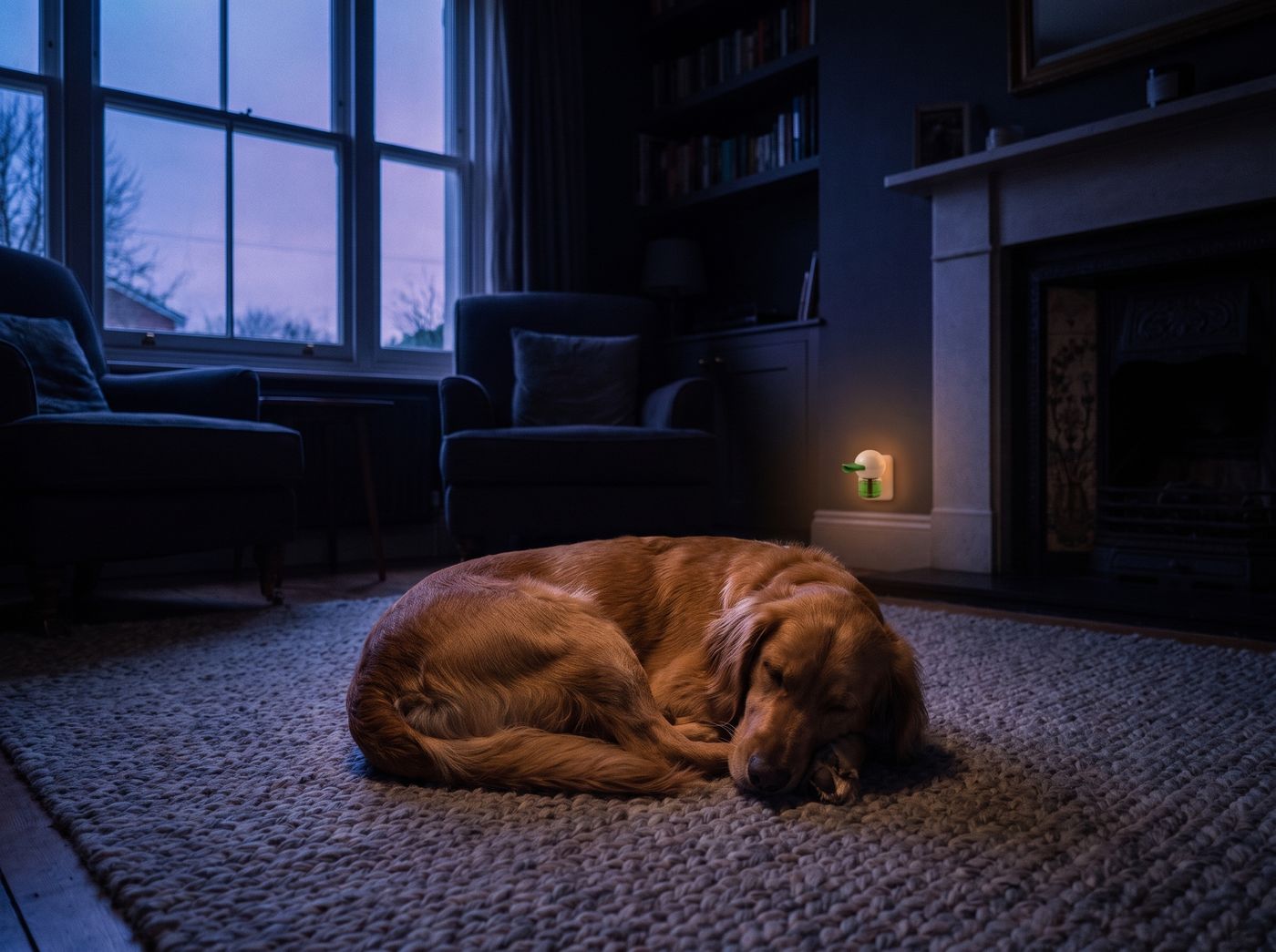
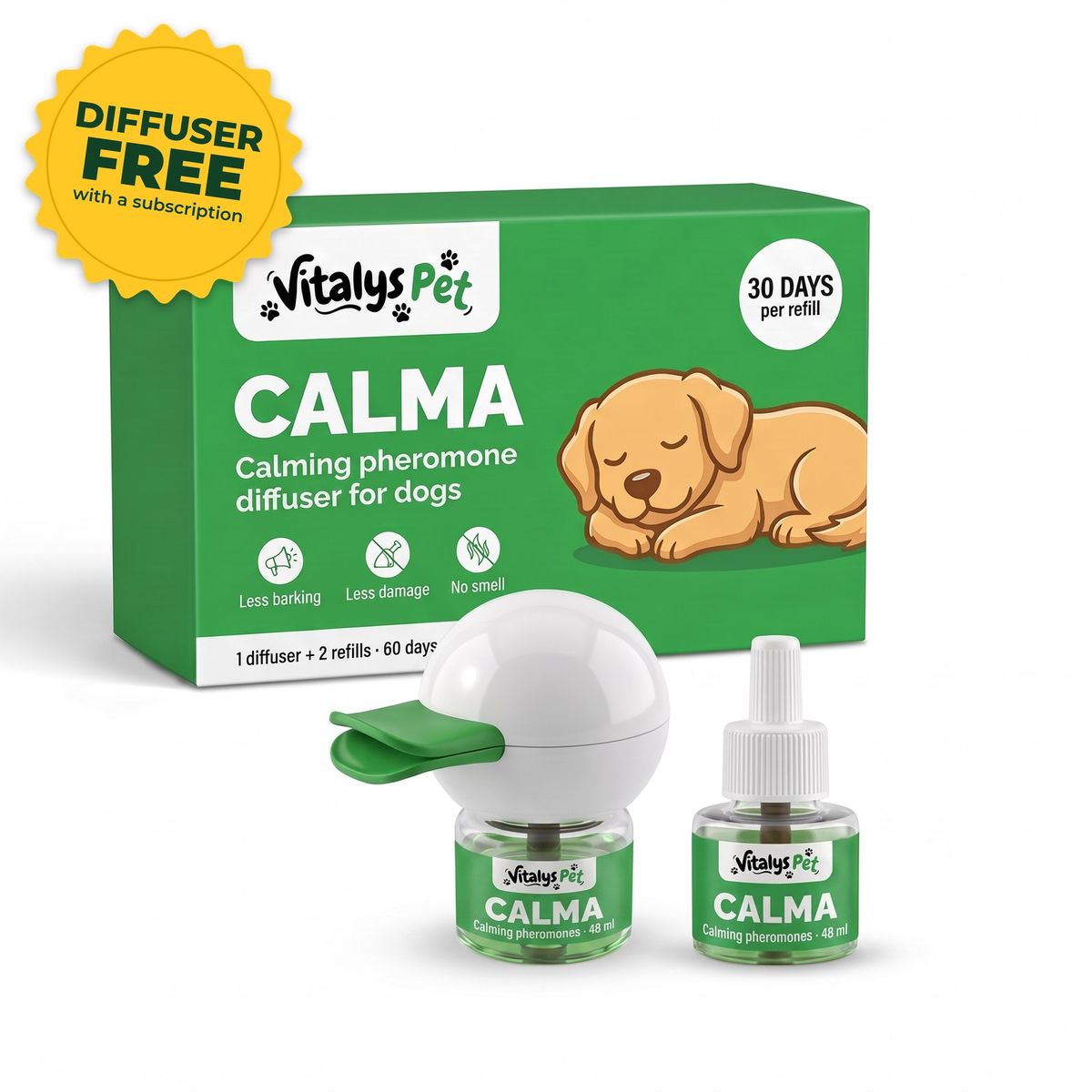
The signal travels through a plug-in diffuser. It sits in the wall socket and releases the all-clear continuously, 24 hours a day, across up to 70 square metres — about the size of an open-plan living room.
It's called Vitalys Calma.
And now, the piece nobody tells you.
The piece the 1-star reviews all miss. The difference between "it did nothing" and "I got my evenings back."
The signal only works if it never gaps.
Owners don't notice it working... until it runs out. That was almost a universal truth in the reviews I read.
One woman wrote: "I accidentally let it run out and seen the difference straight away — ordered the refills and there a lot calmer again."
Another: "I really notice the difference whenever it runs out!"
A third: "I think they work but always forget to check if they run out."
Here's why.
The signal builds up over a couple of weeks. Then it holds a steady baseline.
Break that baseline and you yank the safety net out from under him. Let the diffuser run dry. Plug it in only when you go out. Use it for a few days, then stop.
The alarm roars back. And you think: "This thing doesn't work."
But it did.
You just took it away before he could trust it.
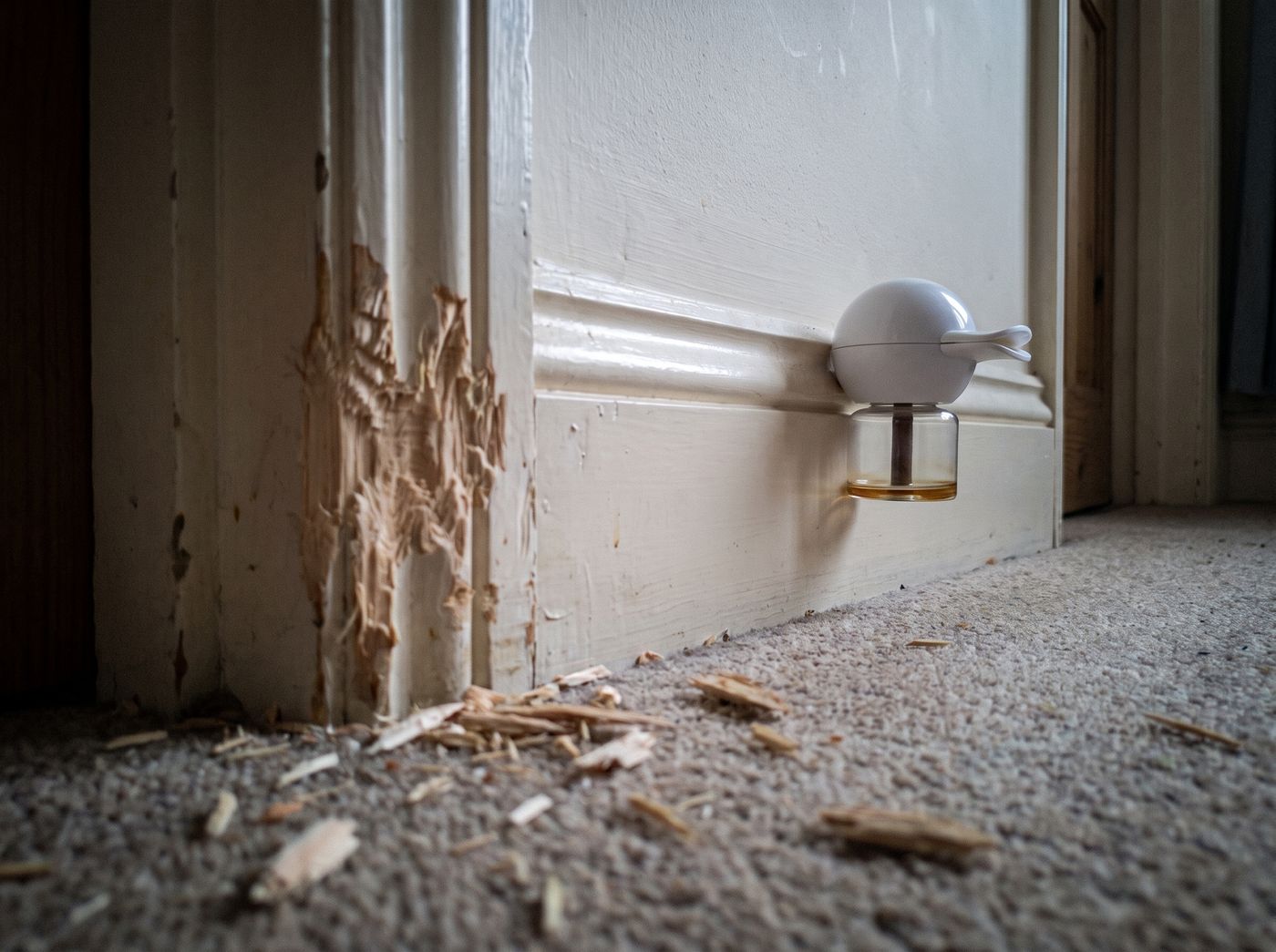
That's why the most successful owners I've seen use it every single day, in the room where the dog spends his time alone.
And they never let the refill run out. The subscription sends the next one before the old one is empty.
Kept on, the shift owners describe is gradual — and real.
In the first ten to fourteen days, you might not see much.
Between two and four weeks, you might notice him settling a little faster when you come home.
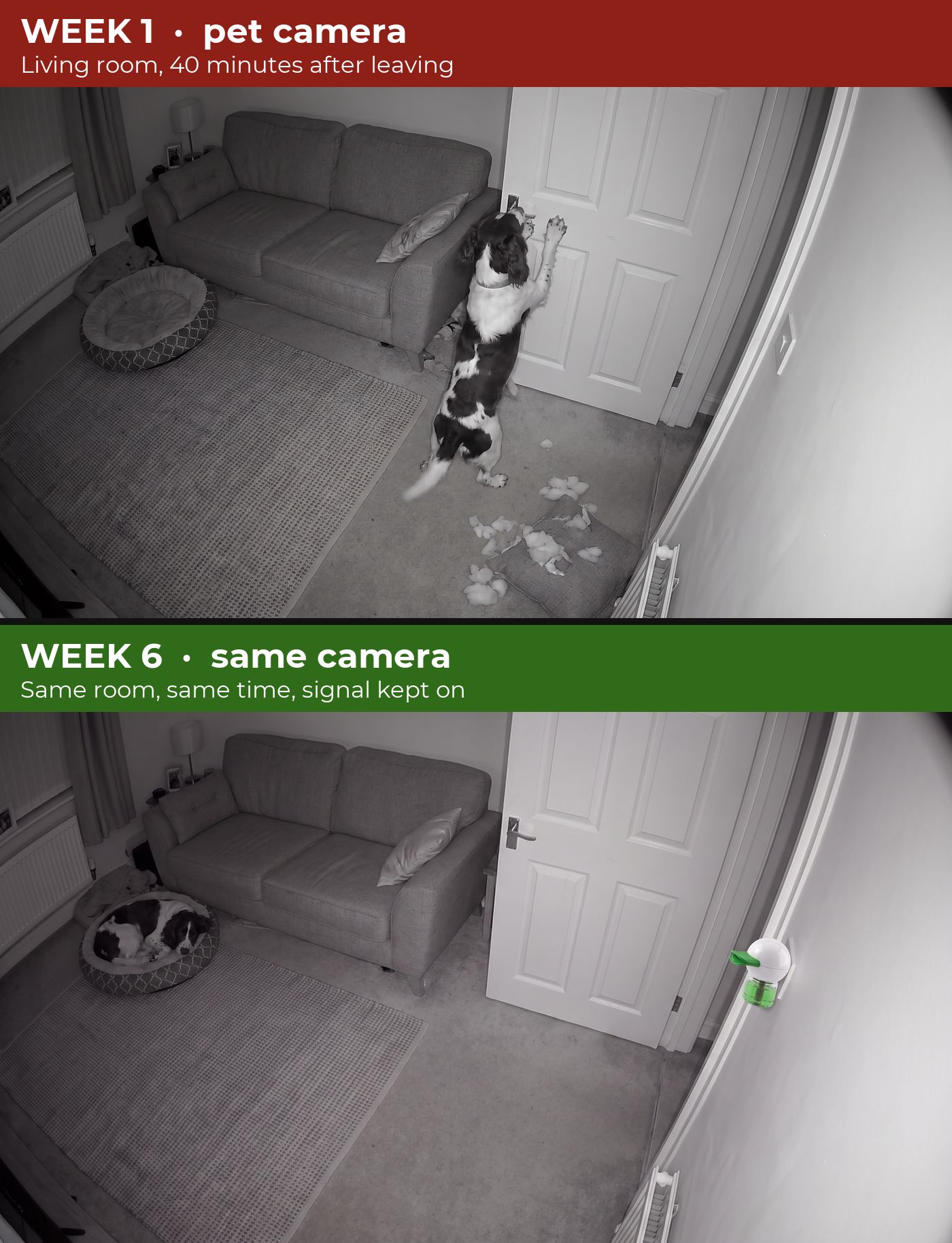
After a month to six weeks, owners often report fewer barking alerts on the camera.
After two to three months, many say they can go to the shop without that knot of dread in their stomach.
Here's what real owners of calming diffusers describe when they keep the signal on:
- "My Hive hub was sending me around 60-100 notifications per hour when I was out... I left him at home alone for an hour and a half whilst I did some shopping... I received 7 notifications!"
- "Since using the diffuser in her favourite room in the house, our neighbours have reported she has stopped the frequent barking and I've come home to see a much happier dog greet us at the door."
- "This product has changed our lives. I have gone from feeling sad and hopeless about our future to feeling so positive about my wonderful little friend."
THIS BREAKTHROUGH IS UPSETTING THE "JUST CRATE HIM" CROWD
There are people who will tell you this is nonsense.
They're the same people who told you to crate him. To ignore him. To "be the alpha." To stop spoiling him.
"It's just a dog." "He'll get over it."
They're the relatives who visit, tut, and say, "Your dog picks up on your anxiety, you know." As though your racing heart were the cause — and not the effect of a dog screaming in the next room.
So hear this from me, a veterinary behaviourist with twenty years of clinical experience:
You are not the cause of your dog's panic.
You are not making him worse.
You are the person who has been desperately trying everything to help, while the world handed you solutions that were never designed to address the real problem.
The "just crate him" crowd have never seen a dog chew his own gums bloody trying to escape.
They've never had a note pushed through their door.
They've never sat in a car park crying because they couldn't face going home to a destroyed house and a trembling dog.
You have.
You've been fighting a battle they don't even know exists.
And what I'm telling you — what the science and thousands of owners are confirming — is that there is a way to switch off the alarm at the source.
Without hurting him. Without drugging him. Without turning him into something he's not.
WHEN YOU CHALLENGE THEM, THEY COME FOR YOU
I've been in practice long enough to know what happens when you find something that really works. Something that makes the old guard look outdated.
You get pushback.
Some will call this a gimmick. "Just a plug-in" — as if the format decided the effect.
They'll say you need "real training." By which they mean a method that requires you never to leave your dog alone for six months.
So let me be absolutely clear: I have never once said a diffuser works on its own.
A dog in full panic cannot learn anything.
Imagine being terrified of spiders. Now someone puts you in a room full of them and asks you to study a foreign language.
That's what "training" a panicking dog looks like.
The all-clear signal brings the panic down to a level where the training — the short absences, the routine, the positive associations — finally has a chance.
It makes the training possible. It creates the headroom.
So when the "just crate him" crowd sneer at a diffuser, they're missing the entire point. The crate, the training, the behaviourist — they all work better when the background alarm is quiet.
The signal doesn't replace the work you're doing.
It underpins it.
THE PLUG-IN DIFFUSER THAT'S MAKING THE CRATE-AND-COLLAR CROWD NERVOUS
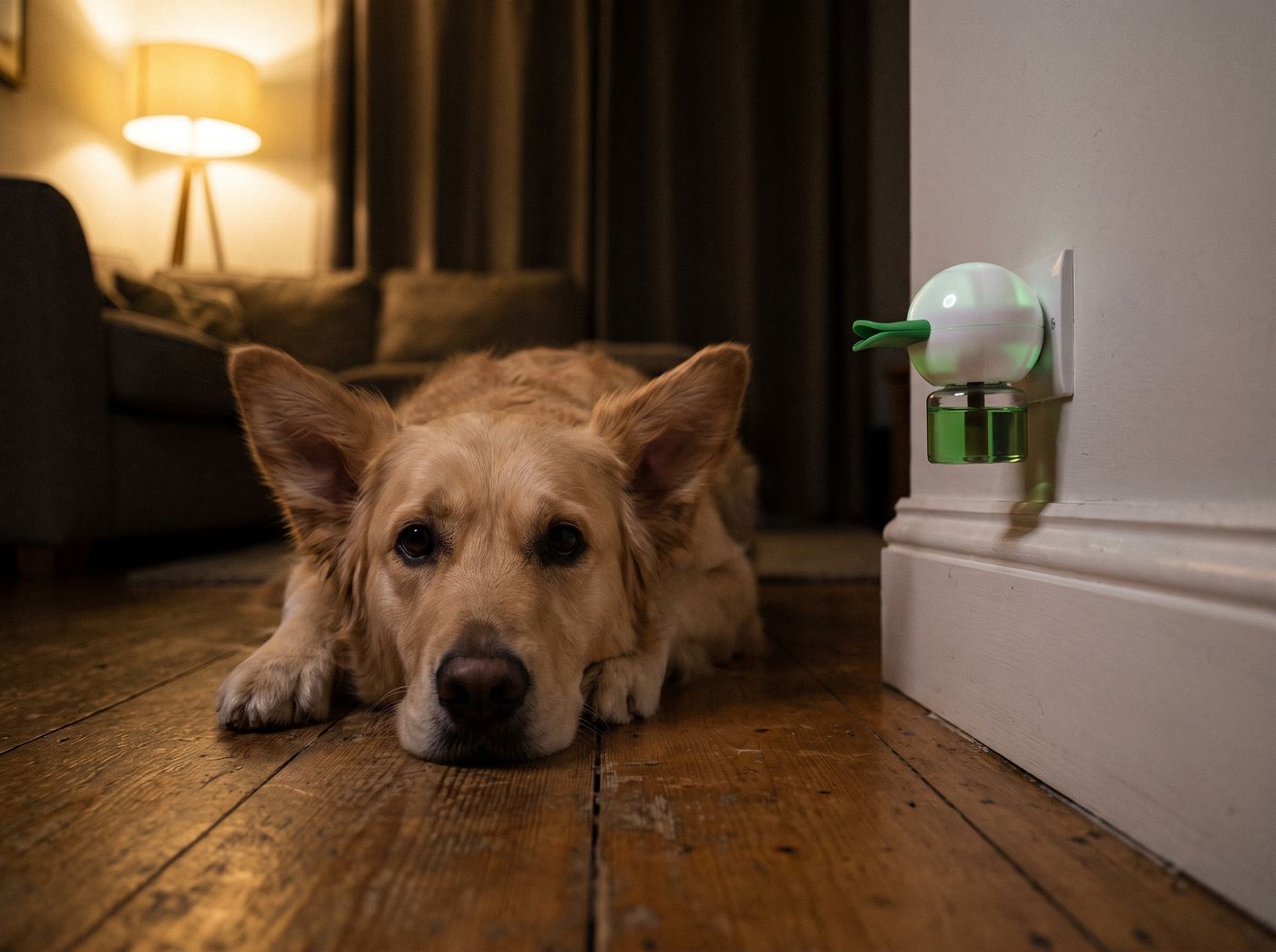
Vitalys Calma is straightforward.
One diffuser plugs into any wall socket. It releases a synthetic copy of the all-clear signal across up to 70 square metres — the size of a typical living room or open-plan kitchen area.
One refill lasts 30 days of continuous diffusion. The plug is supplied to fit your country's socket.
It's odourless to you. It's not a sedative. It doesn't change who your dog is.
What changes is the baseline.
The edge comes off. The alarm doesn't spike the moment you touch your keys. And the silence in your house when you're out is actual calm — not terrified shutdown.
Here's the timeline most owners describe when they use it correctly.
Notice that word: correctly. It means on 24 hours a day, in the room where he stays when you leave, and never allowed to run out.
Days 1–14: The signal builds.
You might not see a difference yet. That's normal. The all-clear is not a light switch — it's a baseline that has to accumulate in his environment.
Keep it plugged in. Don't unplug it at night. Don't move it around. Let it become a constant.
Days 15–30: The edge softens.
He may settle a little faster after you leave. The camera might show him lying down after ten minutes instead of pacing for an hour.
Your neighbour might say, "He was quiet today."
You'll still have hard moments. But the trend is heading the right way.
Days 30–60: The trust builds.
His brain learns: The all-clear is on. It's been on for weeks. It was on yesterday, and the day before, and nothing terrible happened.
The panic doesn't vanish. But it doesn't spike as fast, or as high.
You go to the shop for twenty minutes and you don't dread what you'll find.
After 60–90 days: Life gets bigger again.
This is where many owners say something I never get tired of hearing:
"I'm not holding my breath when I put my key in the lock anymore."
The alarm is still there. It might always be. But it's no longer running his life.
Or yours.
And then comes the critical part: you don't stop.
Think of blood pressure medication. You take it because your blood pressure needs managing — not because you're trying to cure it in a month. Stop, and the pressure climbs back up.
The diffuser works the same way.
The damaged neurons, the over-rehearsed panic pathway — they're still there. The all-clear signal keeps them suppressed.
Let the signal drop, and the alarm remembers its old job.
That's why the subscription is part of the mechanism.
The refill arrives before the old one runs out. There is never a gap.
Because the gap is where the progress unravels.
The owners who say "it didn't work" are often the ones who used it for two weeks and stopped. Or let it run dry and waited a week to replace it. Or plugged it in on the day of the problem and expected a miracle by lunchtime.
The signal is not a rescue remedy. It's an environmental baseline.
And a baseline requires consistency.
Check availability →WHAT OWNERS DESCRIBE
Across those 11,106 stories, one thread ran through the owners who succeeded with calming diffusers.
They didn't describe a "cure."
They described a shift.
They used words like "calmer baseline," "takes the edge off," "a couple of centimetres off the stress scale." They didn't say "perfect."
They said "better."
And "better" was enough to change their lives.
These are the themes that came up again and again — not as guarantees, but as the realistic, honest experience of owners who used the diffuser as part of a wider approach:
What none of these owners said: "It was magic." "It worked overnight." "I never had to train him again."
What they did say: "The diffuser gave me my dog back — not a zombie, not a sedated version, but the dog I knew he could be when he wasn't terrified."
That, right there, is the whole point.
Check availability →THE PRICE
You've already spent a fortune. So let's be honest about what the "solutions" have cost so far.
The behaviourist at £150 an hour. The app at £90 plus £19 a month. Fluoxetine at £95 a month. Trazodone at £42 a month. Separation medication generally "upwards of £100 a month."
The dog walker who cancelled. The crate that ended up bent and bloody. The camera that just showed you his panic in high definition.
One owner said she'd spent "thousands of dollars on medication and training." Another: "£3k worth of vets and trainers down the drain."
And still, the alarm was ringing.
Now here's what Vitalys Calma costs.
A Kit 1 — one diffuser and two refills, enough for 60 days in one room — is normally €63,90. Right now, it's €39,90.
A Kit 2 — two diffusers and four refills — normally €127,90. Today: €67,90.
A Kit 3 — three diffusers and six refills — normally €191,90. Today: €87,90.
Choose Subscribe & Save and you get 25% off every delivery — and the diffuser is free.
Kit 1 on subscription is €29,93 per delivery.
That's less than €0,50 a day to keep the all-clear signal on in the room where your dog needs it most.
Each shipment brings two refills — 60 days of continuous coverage — and arrives before the old ones run out. Pause or cancel anytime.
Now compare.
Another £150-an-hour session that tells you to never leave your dog alone? Another prescription that leaves him staring at the wall? Replacing a door frame? Moving house because your landlord has had enough?
Less than €0,50 a day is the smallest line on the bill of everything you've tried.
Check availability →THE OFFER + THE HONEST REALITY
I'm not going to put a countdown clock on this page.
I'm not going to tell you there are only 47 left and a woman in Brisbane is about to buy them. That's not how I work.
But here is the honest truth.
The demand for Vitalys Calma this month has been higher than we expected. Stock is limited.
The 54% off we're offering on kits right now is available while this batch lasts. When it sells out, the price goes back up to normal retail.
This page will still be here. The price will be higher.
The offer can be withdrawn once this month's batch sells out.
That's the reality. Not a marketing trick. An honest limit on how many units we can supply at this price while maintaining the quality of the formula and the reliability of the refill cycle.
If you come back tomorrow and the discount is gone, that's why.
MY PERSONAL 90-NIGHT GUARANTEE
You've been burned before. I know.
Collars that did nothing. Trainers who made you feel like a failure. Medication that turned your dog into a ghost.
So here's my promise to you.
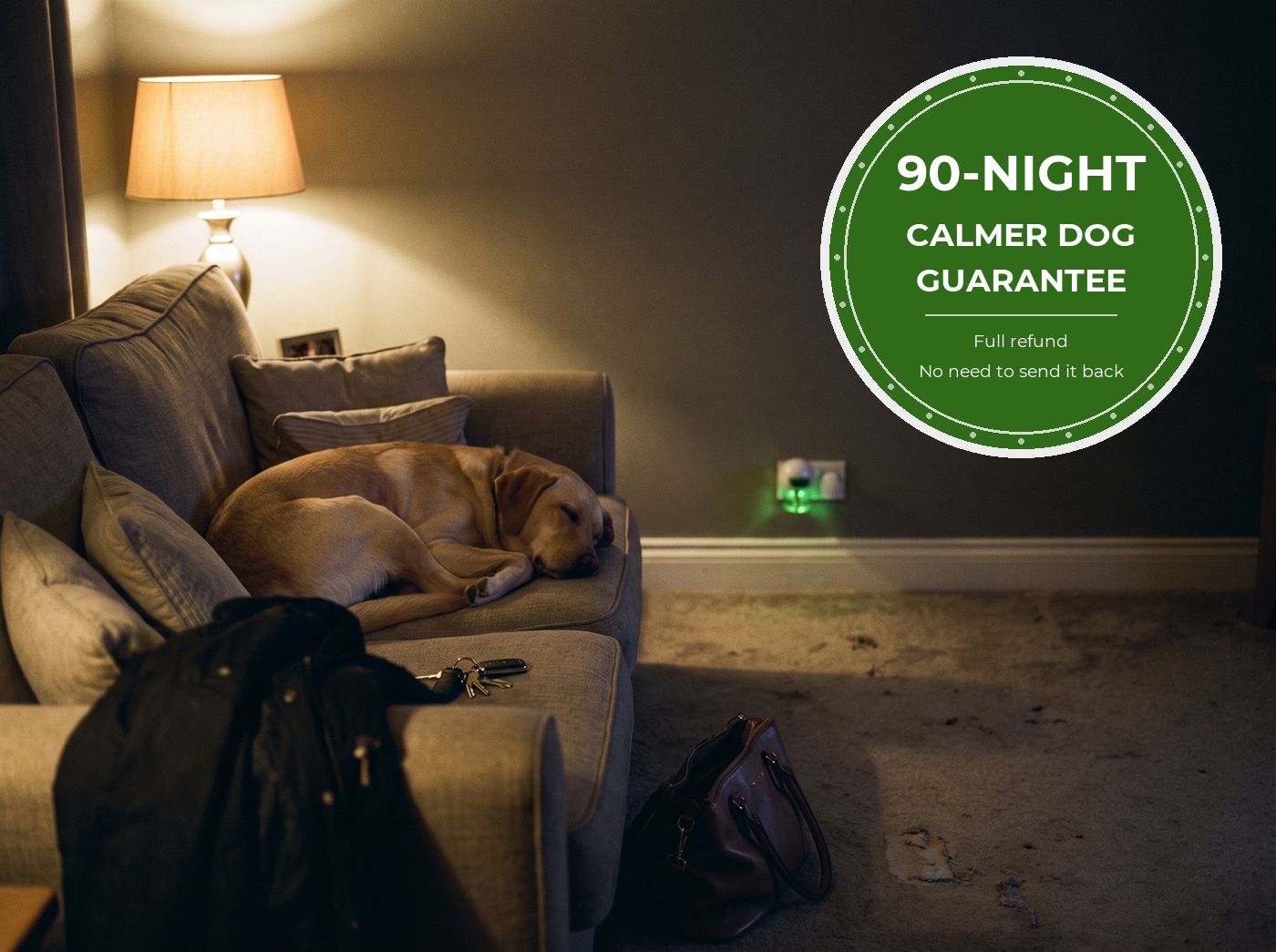
Try Vitalys Calma for 90 nights.
Plug it in. Keep it on. Let the signal build.
Use it alongside the routine you already know: the short absences, the calm departures, the camera if you have one. Give it time to become the environmental baseline your dog has never had.
Notice the mornings when you pick up your keys and he doesn't immediately start panting.
Notice the afternoons when your phone doesn't buzz with barking alerts.
Notice the evening you walk in the door and he's pleased to see you. Not frantic. Not trembling. Just pleased.
And if after 90 nights your dog isn't calmer — less barking when you leave, less destruction, calmer nights — write to us and we'll refund your complete kit.
No forms. No questions. No need to send anything back.
Just send us an email with your order number.
Why can I promise this?
Because I've seen what happens when the all-clear signal stays on. I've read the stories. I've seen the emails. I know the diffuser does exactly what I've described — if you use it the way I've described.
And if it doesn't work for your dog, I don't want your money.
I want you to have a solution that does.
Check availability →THE DECISION
You're standing at a fork in the road.
Path one: keep doing what you're doing.
Keep scheduling your life around his panic. Keep opening your phone to barking alerts. Keep bracing yourself for the note on the door.
Keep spending money on solutions that were never designed to touch the root cause. Solutions with a track record in your own life of "it helped for a bit, and then it didn't."
Keep hoping he'll get used to it — knowing in your gut that he's actually getting worse.
Keep feeling like a prisoner.
Path two: try something that addresses the alarm itself.
Spend less than the cost of a single behaviourist session on a kit that gives you 60 days of continuous all-clear signal. The background support your dog has been missing every single time you've tried to leave him alone.
Give yourself the chance to come home to a dog who's calm, not collapsed.
To go to the shop without your heart pounding.
To turn your phone off during a meal out, because you're not watching the camera feed.
Give your dog the signal he was born understanding. The one that says: Safe. All clear. You're not alone.
You've tried everything else.
This is the one thing you haven't been told.
HERE'S EXACTLY WHAT HAPPENS NEXT
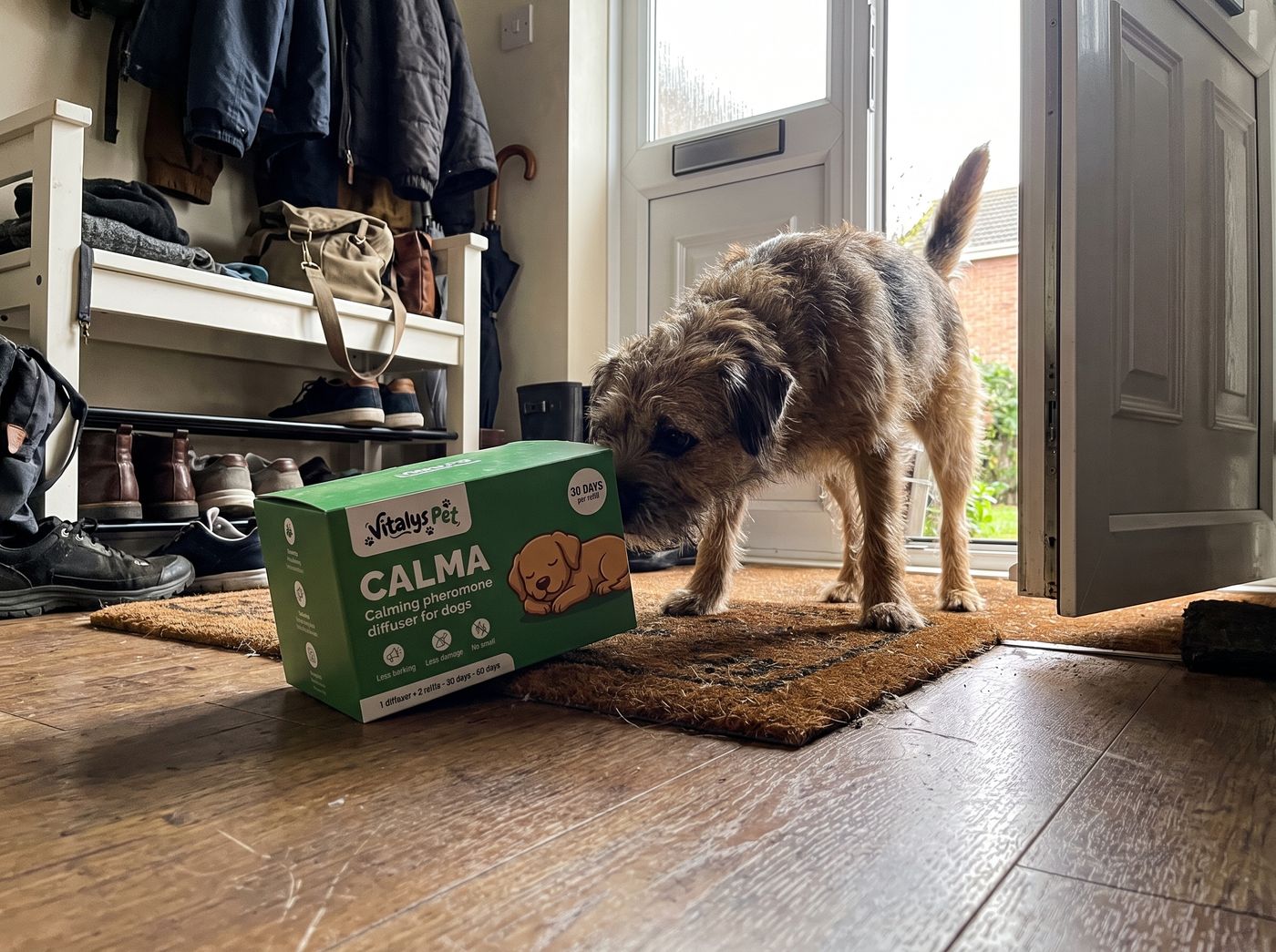
Step 1: Click the button below. You'll go straight to the Vitalys Calma page.
Step 2: Choose your kit. Kit 1 for one room (60 days), Kit 2 for two rooms, Kit 3 for three rooms. Then choose Subscribe & Save — the option owners tend to choose, because they never want the signal to gap — or a one-time purchase.
The subscription is smart. The diffuser is free, the refills are 25% off, and each delivery arrives before the last one runs out.
No remembering to reorder. No running to the shop at 9 pm because you've just noticed the bottle is empty and you have work tomorrow.
Step 3: Enter your shipping information. Delivery takes 5–7 working days, tracked. The plug is sent to fit your country's socket.
Step 4: When the kit arrives, plug it in that same day. In the room where your dog spends most of his time when he's alone. Don't wait until the morning you're leaving. Plug it in now, and let the signal start building tonight.
Step 5: Keep it plugged in. Do not unplug it at night. Do not take it out when you're home. The all-clear is a baseline, not a quick fix — let it become the wallpaper of his environment.
Step 6: In 30 days, when the refill is close to running out, your subscription will already be sending the next one. No gap. No regression. No "I accidentally let it run out and seen the difference straight away" moment — except to confirm it's working.
And then — this is the part I want you to email me about — one day you'll come home and realise you didn't think about the camera the whole time you were out.
But don't wait until "later."
"Later" is another week of your dog rehearsing panic.
"Later" is another complaint from the neighbour who's been keeping a log.
"Later" is another morning of dread when you touch your keys.
"Later" is your landlord sending the formal letter.
"Later" is the thought you can't say out loud — the one about rehoming him — creeping back into your head at 3 a.m.
"Later" is the price going back up, the discount gone, and you wishing you'd done this today, when it was all in front of you.
Check availability →Your dog has been waiting for the all-clear signal his whole life.
You've been waiting for your life back nearly as long.
One click.
Veterinary Behaviourist, 20+ Years in Practice
Reader of 11,106 Owner Stories
And the One Who Finally Got Bloody Furious Enough to Find the Answer
P.S. — Remember Claire? The note through her door after 40 minutes at the shop? Six months after she put the all-clear signal in her living room, she sent me an update. No notes. No complaints. No frantic dog when she walks in. "I took the bins out this morning," she said, "and I didn't even think about it until I was back inside." That can be you. But only if you start.
P.P.S. — Stock is genuinely limited this month. We have a batch that covers orders at the 54% discount, and when it goes, the price returns to normal. No games. No fake countdown. Just the most honest thing I can tell you: if you're reading this now, the discount is still on. Come back tomorrow and it might not be.
P.P.P.S. — To the "just crate him" crowd: you have never sat in a car park at 7:30 a.m. crying because you can't face another morning of it. I'm not interested in your opinion. I'm interested in what actually helps dogs and their owners. And the data from 11,106 stories is clear: the alarm is real. And the all-clear signal — kept on, every day, without gaps — is the thing that quietens it.
P.P.P.P.S. — The biggest mistake I see: owners notice their dog is calmer after 6–8 weeks and "save money" by skipping a refill. Within two weeks, the barking is back. The panic is back. The prisoner feeling is back. The alarm never went away — it was only suppressed. The subscription exists so you never have to choose between your budget and your dog's baseline. The owners who succeed are the ones who never let it gap.
Check availability →